Multispectral calibration relates recorded image values to surface reflectance. Panel captures, illumination observations and processing settings establish the basis for comparing flights. Preserve those inputs with the crop map and the field observations used to interpret it.
Table of Contents
What does radiometric calibration change?
Radiometric calibration concerns measured brightness and reflectance, while geometric calibration concerns where features appear. A well-aligned mosaic can still contain inconsistent radiometry. A reflectance product remains a measurement of the observed scene, not a diagnosis of its biological condition.
Identify the supported path from raw digital values through the selected sensor’s radiometric model to the final band products. Confirm whether software expects raw imagery, corrected imagery or panel-derived factors. Applying a correction twice is not additional quality assurance.
MicaSense’s explanation of calibrated reflectance panels describes a band-specific relationship between panel radiance and known reflectance. The important acceptance question is whether the complete calibration record survives—not whether the software offers a button called “calibrate.”
Capture a usable panel record
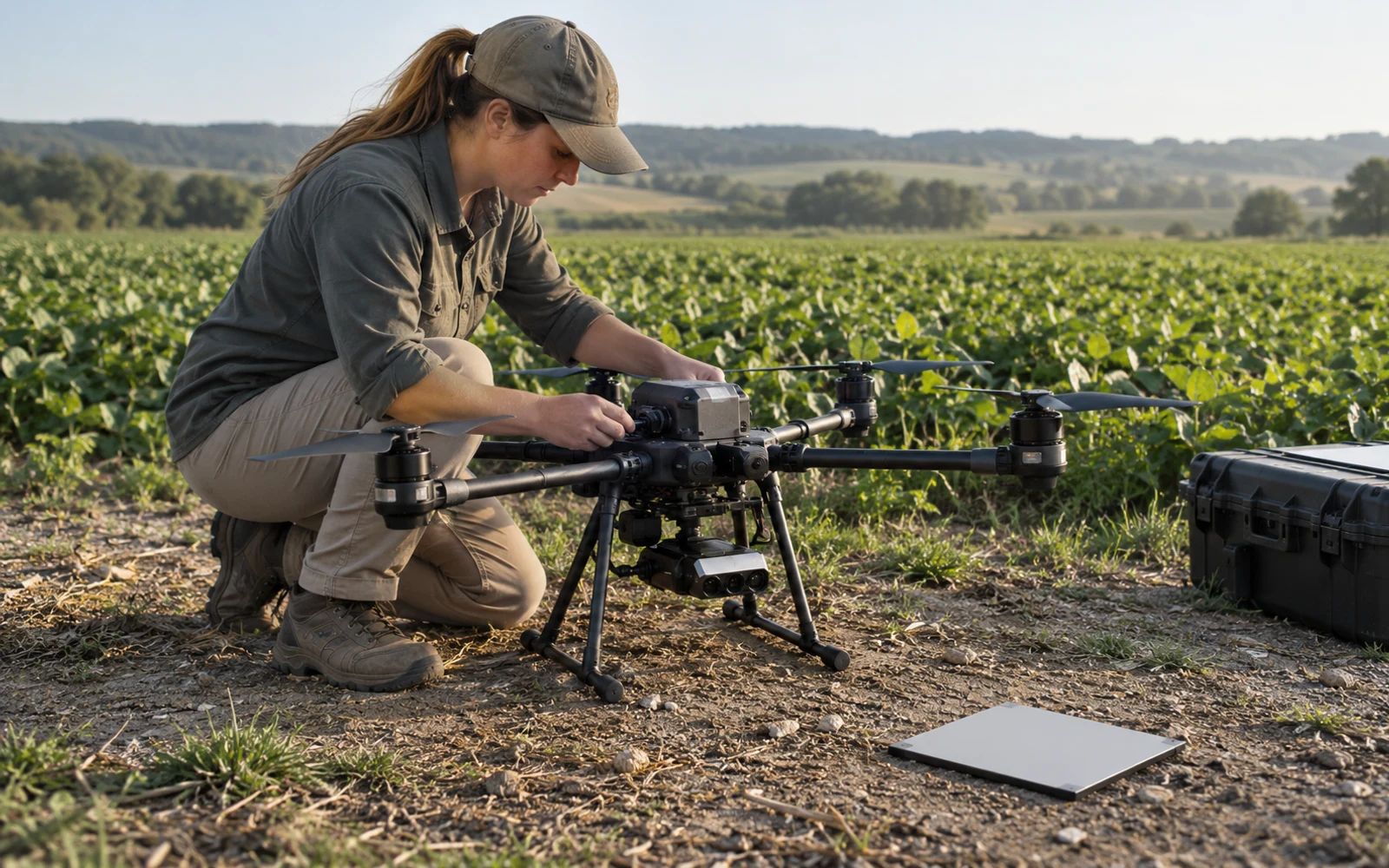
Inspect the target before the flight. Record its identity and use its applicable calibration information rather than a generic value copied from another panel. Protect the measurement surface from contamination and handle it according to its instructions.
MicaSense’s panel capture guidance recommends captures immediately before and after each flight and explains how shadows and reflected light contaminate them. Treat these as instructions for that workflow; another camera may require different controls.
Confirm that the correct band files exist, the target is unobscured, the capture is not saturated and the images can be associated with the intended flight. Check while another capture is still possible. A filename alone is weak evidence if several aircraft or camera sessions share a memory card.
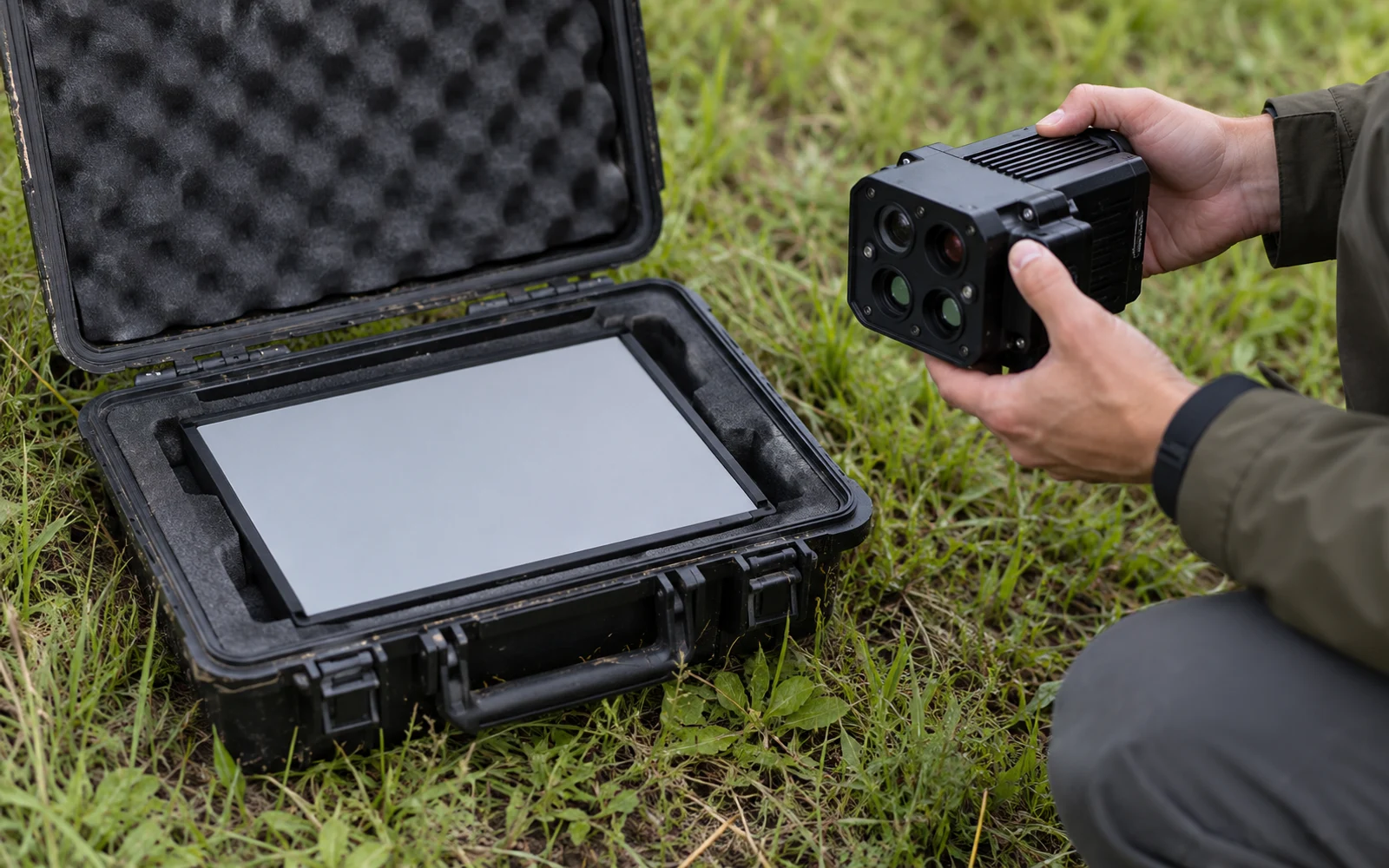
The crop-monitoring equipment guide covers camera and aircraft purchasing. Here, the deliverable is a usable calibration package for an acquisition, not another comparison of airframes.
Why does changing cloud cover remain a problem?
A panel capture samples illumination at a particular moment and place. It cannot automatically describe every patch of ground during a flight through changing shadows. An irradiance sensor supplies additional observations, but its view, orientation, timing and supported processing model still matter.
The manufacturer’s data-collection guidance discusses shadows and variable ambient light. Inspect flight strips and overlap areas for illumination-related discontinuities before comparing dates. Do not interpret every change in an index layer as a crop response.
A useful field note states what changed and when: a cloud bank arrived, a flight was interrupted, the panel was moved or the sensor configuration changed. Keep this separate from later interpretation. A note saying “good data” does not help an analyst locate a problem.
Resolve calibration exceptions before mosaicking
The following suggested quality controls are not universal manufacturer acceptance thresholds.
| Observation | Check before processing | Defensible disposition |
|---|---|---|
| Panel shadowed or contaminated | Other valid captures and target condition | Replace the capture or mark the limitation |
| Panel identity missing | Flight notes and calibration record | Resolve identity; do not invent reflectance |
| Bands or metadata missing | Sensor file set and ingestion logs | Recover files or exclude unsupported output |
| Illumination changes during flight | Time-linked imagery, irradiance and field notes | Evaluate affected strips; reflight or restrict comparison if needed |
| Processing version changed | Reprocess a retained test set consistently | Separate software effects from scene change |
Choose the comparison rule before examining the result. For a repeated campaign, retain suitable check areas and field observations to investigate processing consistency. Their apparent stability should be established for the task; bare soil is not automatically an invariant reference.
Do not hide questionable areas by smoothing the mosaic. If a seam reflects measurement inconsistency, cosmetic editing makes uncertainty less visible without improving the observations.
Hand over calibrated data with limits
Deliver raw band imagery, valid panel captures, panel identity, illumination records when collected, software settings, output units and a spatial record of exclusions. State whether a layer is reflectance, an index, a classification or a visualization. Similar colors do not make those products interchangeable.
Keep the calibration measurements, illumination observations and processing settings with the resulting crop map. The interpretation brief should explain the field observations used to assess the pattern.
Ask the analyst to reproduce one output from the retained inputs and explain every exclusion. That test is more informative than comparing attractive screenshots. An unresolved calibration gap should narrow the claim a map supports, not disappear from the report.
FAQs
Does radiometric calibration fix image position errors?
No. Radiometric calibration concerns image intensity or reflectance. Geometric alignment and coordinate accuracy need separate checks, even when one software workflow performs both.
Can a shadowed reflectance panel be used for calibration?
Do not accept it simply because the software detects the target. Shadow or reflected light can change panel illumination. Follow the camera method and capture a valid replacement where possible.
Does a calibrated vegetation index diagnose crop disease?
No. Calibration helps make the measurement interpretable, but an index pattern can have several causes. Ground observations and an appropriate agronomic interpretation are still needed.