Time to collision (TTC) and post-encroachment time (PET) describe different aspects of a traffic interaction. TTC depends on a prediction of continued motion; PET describes the interval between successive occupation of a conflict location. Neither number, on its own, establishes crash probability or whether a road is safe.
Table of Contents
How are TTC and PET different?
TTC estimates how long it would take for road users to collide if the assumed motion continues. PET describes the time between one road user leaving a specified conflict location and another occupying it. They can describe the same encounter without producing equivalent numbers.
The FHWA Surrogate Safety Assessment Model user manual defines these quantities within a trajectory-analysis workflow and reports minimum values over identified conflicts. Be clear whether a dataset contains instantaneous values, event minima or another summary.
FHWA’s research overview describes SSAM as using simulated trajectories to analyze indirect safety indicators. Applying related concepts to video-derived tracks does not automatically validate the tracking, geometry or crash-prediction performance of a commercial system.
The first question is therefore methodological: what positions, object footprints and motion assumptions produced this number?
Two calculations that answer different questions
Consider an illustrative straight, same-lane following case. Let the bumper-to-bumper gap be 20 m, the following vehicle’s speed 15 m/s and the leader’s speed 10 m/s. With constant speeds and no path change:
TTC = gap ÷ closing speed = 20 ÷ (15 − 10) = 4 seconds.
Using 20 ÷ 15 would answer a different question. If the following vehicle is not closing, this simple model does not produce a finite positive collision time. Braking, acceleration or changing paths can invalidate the constant-velocity prediction.
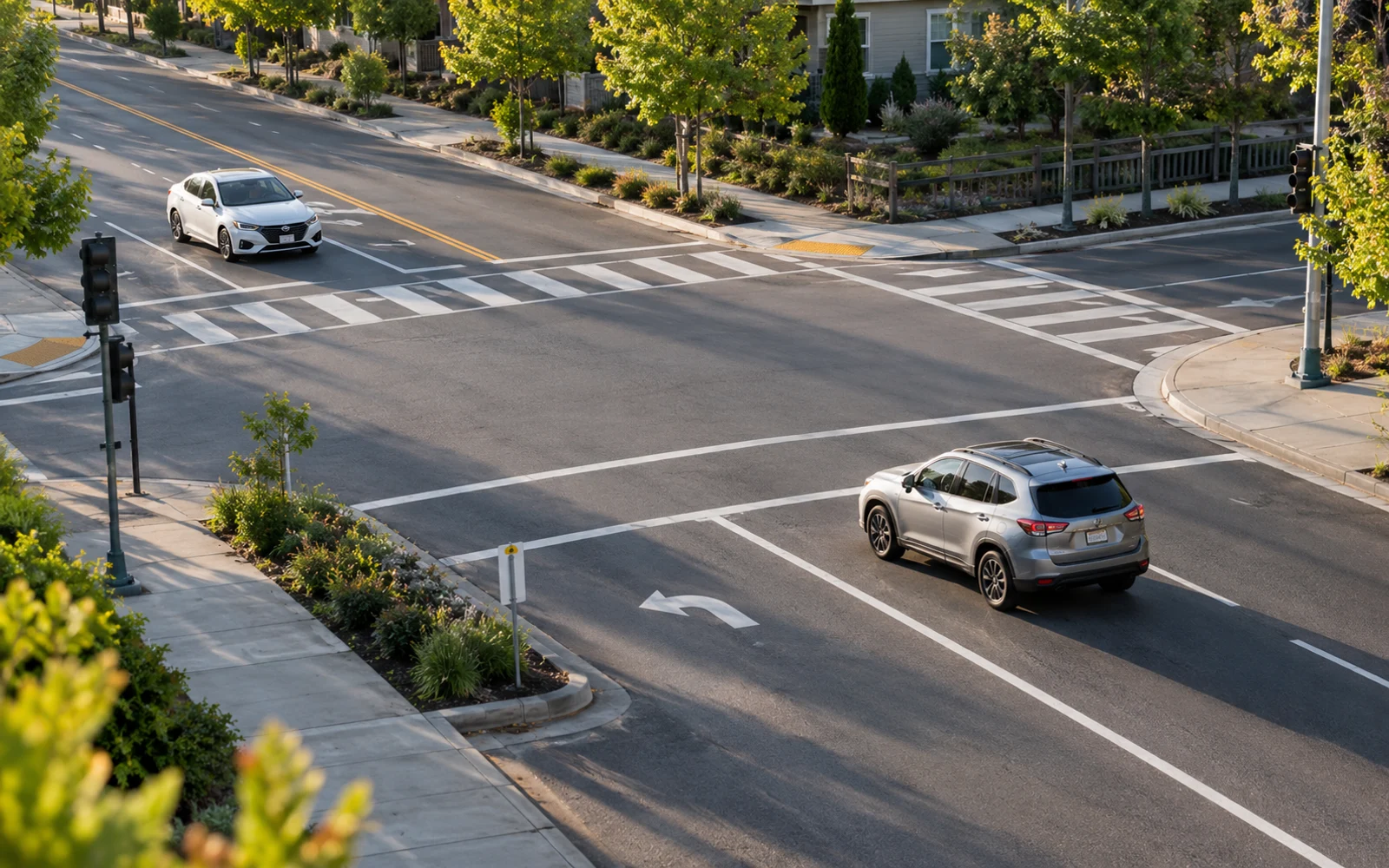
For a separate crossing example, define a conflict region and use vehicle footprints consistently. Suppose the first vehicle finishes occupying that region at 11.2 seconds and the second begins occupying it at 12.4 seconds. The observed PET is 1.2 seconds.
These are invented calculations for explanation, not observed incidents. Changing the conflict-region boundary or using center points instead of full footprints can change the result. State the convention rather than comparing numbers from different definitions.
A comparison contract for trajectory analytics
Before ranking sites or software outputs, agree on the fields below.
| Analysis element | What to document | Consequence if omitted |
|---|---|---|
| Geometry | Ground-plane mapping, path and object footprint | A pixel-distance calculation may not represent road separation |
| Time | Timestamp basis, sampling and synchronization | Small gaps can be distorted |
| Motion model | Constant velocity or another prediction rule | TTC values become incomparable |
| Conflict definition | Point or region, entry and exit convention | PET changes with the chosen boundary |
| Event aggregation | Instantaneous value, minimum or percentile | One encounter can be counted many times |
| Missing data | Occlusion, interpolation and track termination | Apparent near misses may be reconstruction artifacts |
| Exposure | Observation duration and relevant traffic opportunities | Raw event counts can mislead comparisons |
This is a recommended reporting contract, not a universal algorithm specification. The traffic data-quality guide provides the broader treatment of missing, invalid and delayed observations.
Why is one threshold not a safety verdict?
A threshold selects observations under a defined method. It does not transform an uncertain trajectory into a verified conflict or establish the probability of a future crash.
Timing uncertainty matters. If each of the two PET boundary times can be wrong by up to 0.05 seconds, their difference can be wrong by up to 0.10 seconds in a worst-case bound. That example assumes the stated individual bounds are valid; it is not a confidence interval or a claim about a particular camera.
Review speed and interaction type alongside the metric. A short temporal gap at low speed and a high-speed conflict can imply different consequences. Also account for observation exposure: more recorded traffic can produce more flagged events without demonstrating a higher per-opportunity risk.
Do not treat a positive PET as proof that a close encounter was harmless. Nor should a small estimated value be labeled an actual collision without corroborating evidence. Preserve ambiguous cases for review.
Review the event before changing the road
Retain the original clip or trajectory segment, calibration, metric definition, quality flags and software version. Review event-level evidence before interpreting aggregate changes, especially after a camera move, model update or road-layout change.
A sample calculation should expose the trajectory assumptions, excluded tracks and units. Keep these definitions consistent across sites and dates before comparing TTC or PET distributions.
FAQs
What is the main difference between TTC and PET?
TTC estimates time until a collision under a stated motion model. PET measures the gap between one road user leaving a defined conflict location and another arriving. TTC is predictive at an observation instant; PET depends on the observed occupation sequence.
Is gap divided by speed always a valid TTC calculation?
No. A simple rear-end TTC uses closing speed, not the speed of one vehicle alone, and assumes an aligned path and continued velocities. Crossing paths require a suitable trajectory and geometry model.
Can one TTC or PET threshold prove a site is unsafe?
No. A threshold can define a review set within a stated method, but interpretation also needs exposure, trajectory quality, speed, geometry, uncertainty and event context. It should not be presented as a universal safety verdict.