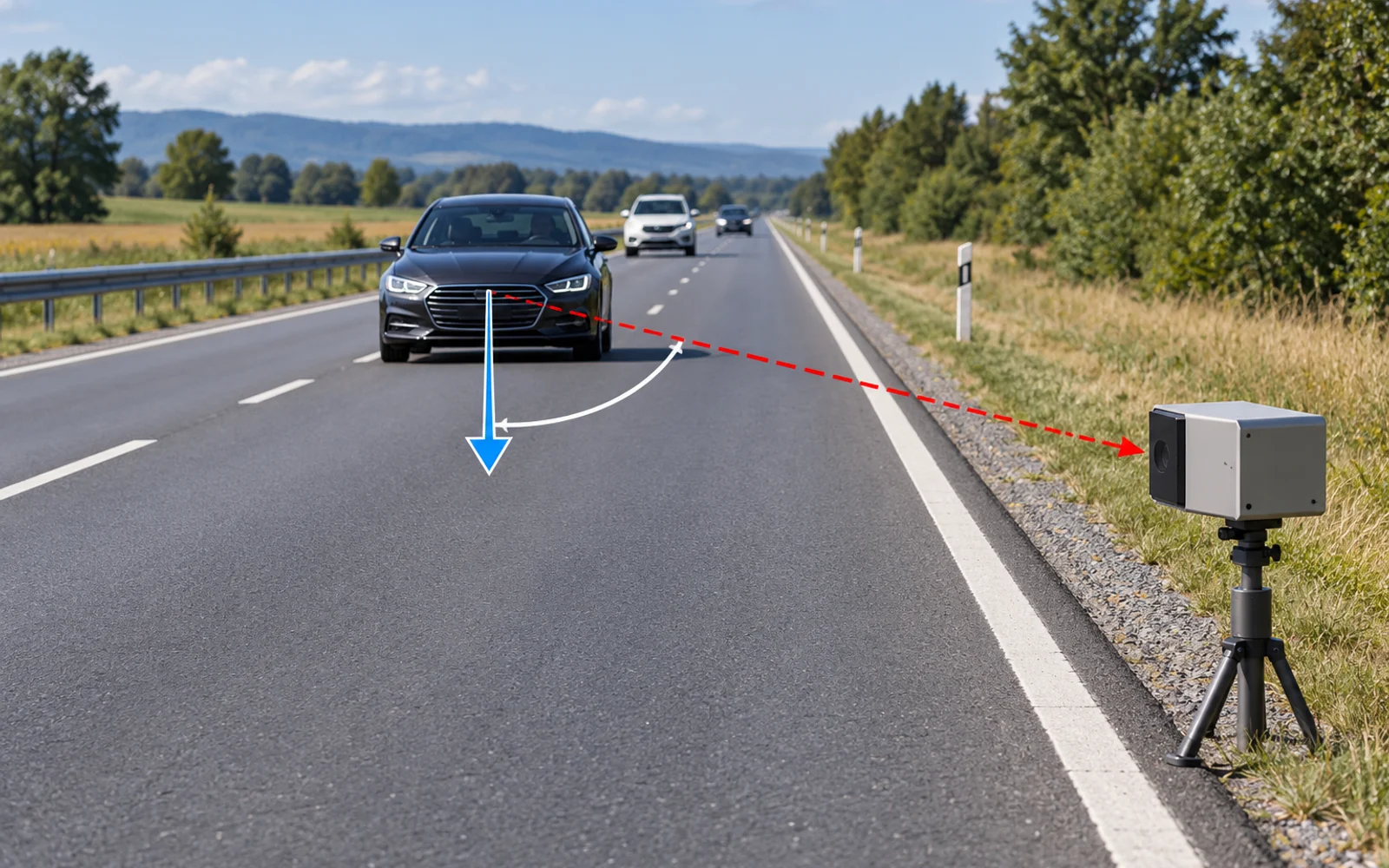
A radar observes motion through its measurement geometry. For a simple Doppler measurement, the radial component of vehicle speed is smaller than road speed when the vehicle travels at an angle to the radar sight line. Modern traffic sensors may already compensate or derive speed from tracks, so the output definition comes before any correction.
Table of Contents
What is the basic cosine relationship?
For an ideal radial Doppler observation, vr = v × cos θ, where v is vehicle speed and θ is the angle between its direction of travel and the radar line of sight. The equation describes a component of motion, not every field labeled “speed” in a traffic sensor.
FHWA’s detector handbook explains microwave sensing and its dependence on measurement geometry. Use the exact sensor documentation to determine whether its output is radial, angle-compensated, road-aligned or derived from successive positions.
| Illustrative road speed | Angle | Ideal radial component |
|---|---|---|
| 60 km/h | 0° | 60.00 km/h |
| 60 km/h | 10° | 59.09 km/h |
| 60 km/h | 20° | 56.38 km/h |
| 60 km/h | 30° | 51.96 km/h |
These are mathematical examples, not a legal tolerance, enforcement procedure or measured performance claim.
Why can a second correction make the result worse?
If the device has already converted its measurement to road speed, dividing again by a cosine increases the value incorrectly. A field name alone rarely establishes the processing history.
Request the output definition and configuration dependencies. Record whether the sensor uses a fixed angle, lane geometry, target bearing or a track fit. Keep the accepted mounting configuration with the interface version.
Near-perpendicular observations are especially sensitive: the radial component becomes small and division by a small cosine magnifies uncertainty. The simple equation cannot be used to claim that any mounting geometry can be repaired in software.
One pole can contain several viewing angles
The angle to a vehicle changes as it moves through the detection area. Adjacent lanes have different geometry, and bends or lane changes alter the vehicle’s direction.
Review the specific location at which the device assigns a speed. A pass-level average, entry speed and speed at a reference line may all be legitimate but different outputs. Compare the same definition in the reference system.
How should field verification be arranged?
Use an approved, independently characterized speed reference and match individual vehicles at the same location and time as closely as the method requires. Record uncertainty in the reference as well as the radar.
Break results down by lane, range, direction, speed band and vehicle type. Include the difficult parts of the accepted zone. An overall mean can hide a position-dependent bias that matters to the intended application.
Preserve raw records, pairing rules and excluded observations. If the reference and sensor sample at different points, account for acceleration rather than attributing every difference to cosine error.
The traffic sensor calibration guide covers the wider maintenance process. This geometry check is only one part of that process.
What should change after the mount moves?
Recheck physical alignment, stored geometry and representative speed comparisons after pole work, sensor replacement or a changed lane layout. A small mechanical change may not be visible on a general dashboard.
Version the configuration and mark the transition in the data archive. Historical records generated under the old geometry should remain identifiable. Do not silently apply a new angle to old data unless a documented reprocessing method justifies it.
Specify the speed field before buying the sensor
Retain the speed definition, installed geometry and reference comparison with the sensor configuration. Repeat the comparison after a mounting or road change that alters the viewing angle.
If the application involves enforcement, its approval and evidentiary requirements need their own assessment; a successful traffic-management comparison does not establish enforcement suitability. The speed-enforcement overview explains that broader distinction.
FAQs
Does an angled radar always report a lower final vehicle speed?
Not necessarily. A raw radial Doppler value has a projection effect, but the device may compensate for geometry or derive road-aligned speed internally.
Should exported speed always be divided by cos theta?
No. First verify whether the exported field is raw radial speed or an already corrected quantity. Applying a second correction can introduce error.
Can one mounting angle describe every vehicle in a wide zone?
Often it cannot. The sight-line angle can vary with vehicle position, lane and road curvature, so validation should cover the full reporting zone.