Turning movement counts describe where road users enter and leave an intersection during defined intervals. A usable count needs more than a total: movement labels, classification rules, observation coverage and queue context determine whether the numbers can support signal analysis or a repeatable traffic study.
Table of Contents
What does a turning movement count count?
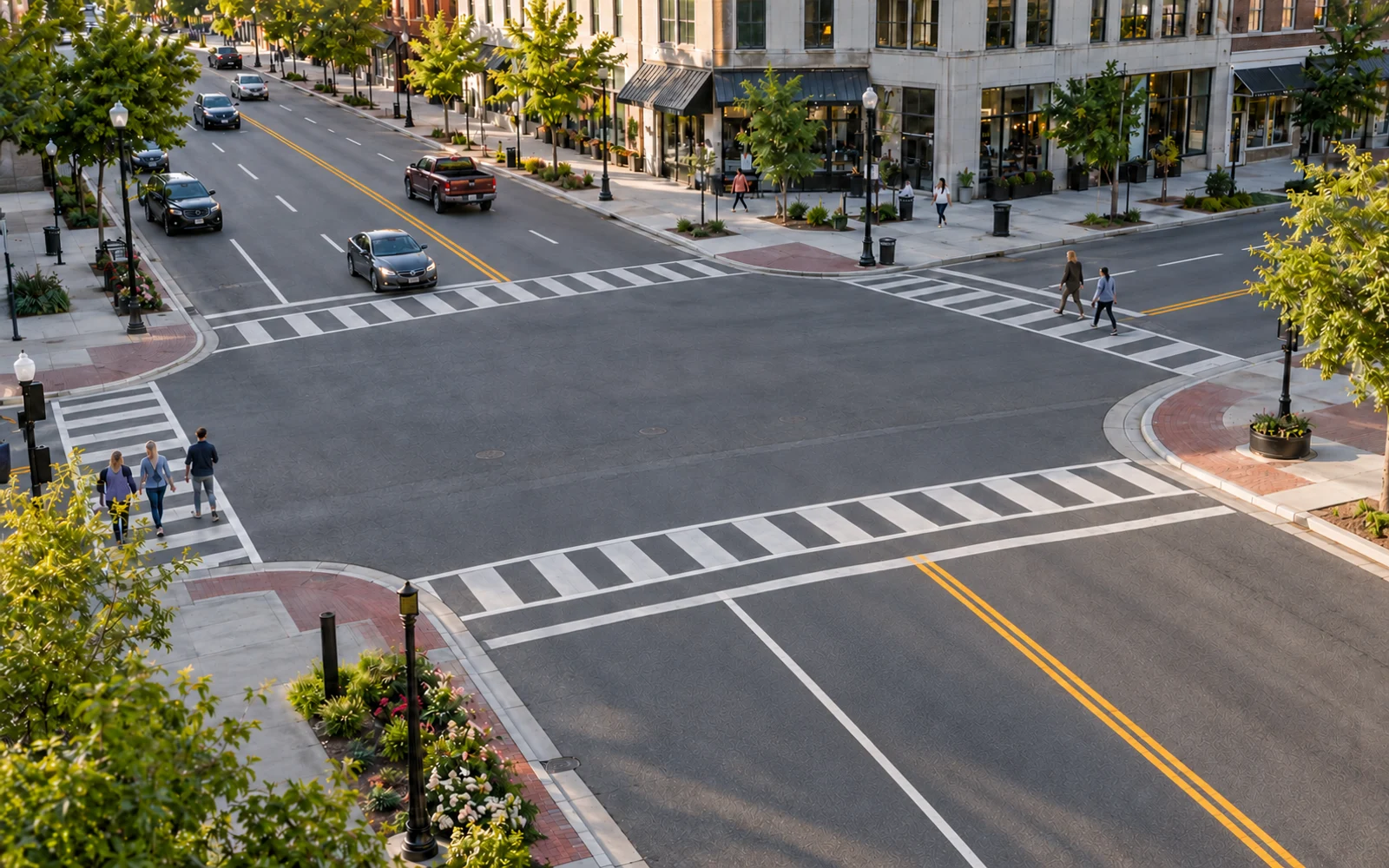
A turning movement count assigns observed road users to paths through a defined intersection. The result depends on where a movement begins and ends, the interval used and the classification rules.
“Northbound left” should describe the approach travel direction and the turn, not an observer’s position on the map. Attach an approach diagram with street names or stable identifiers so different teams produce the same labels. Define U-turns, shared lanes, slip lanes and unusual movements explicitly.
FHWA’s traffic-analysis data guidance discusses turning movement data by approach and 15-minute increments for CORSIM modeling. That is a documented workflow context, not a claim that every survey must use the same interval. Match the collection resolution to the analysis and retain finer observations when the system supports them.
Freeze the movement map and time intervals
Define a crossing or completion rule before collection. A vehicle entering just before an interval boundary and leaving just after it must not be counted inconsistently across cameras or reviewers.
Use synchronized clocks and record the time zone and any clock correction. A total can look plausible even when one approach is offset into the wrong interval. Maintain lane and movement identifiers through geometry changes rather than silently reusing an old label.
| Count element | Definition to freeze | Quality check |
|---|---|---|
| Approach | Direction and upstream observation boundary | Match labels to the approved site diagram |
| Movement | Entry-to-exit path, including exceptional turns | Review complete tracks, not only lane position |
| Timestamp | Entry, stop-line passage or completed movement | Apply one rule consistently |
| Class | Vehicle or road-user categories | Preserve unknown and mixed-use cases |
| Interval | Start, end and boundary convention | Avoid duplicate or omitted boundary events |
| Coverage | Valid observation time for each movement | Separate zero counts from missing observation |
The detection-zone design guide addresses the geometry behind these events. Do not assume the lane occupied upstream proves the eventual turn; shared lanes and lane changes can defeat that shortcut.
Why can a correct count understate demand?
A departure count measures vehicles that passed the observation point. If a queue grows, some arrivals have not yet departed. FHWA’s discussion of congested intersection analysis warns that ignoring unmet demand can distort capacity and queue analysis.
For a simplified approach with no other entries, exits or diversions:
Arrivals = departures + ending accumulation − starting accumulation.
Suppose 200 vehicles depart during an interval, with 10 queued at its start and 30 at its end. The illustrative arrival total is 220. This is a conservation calculation, not an instruction to add the entire ending queue to every interval.
The boundary must be consistent. If vehicles enter a driveway, change into an unobserved approach or remain outside the defined queue measurement, account for those flows. Approach-level accumulation does not automatically tell you each queued vehicle’s future turn. Preserve that uncertainty instead of allocating it without explanation.
Reconcile ambiguous tracks before aggregation
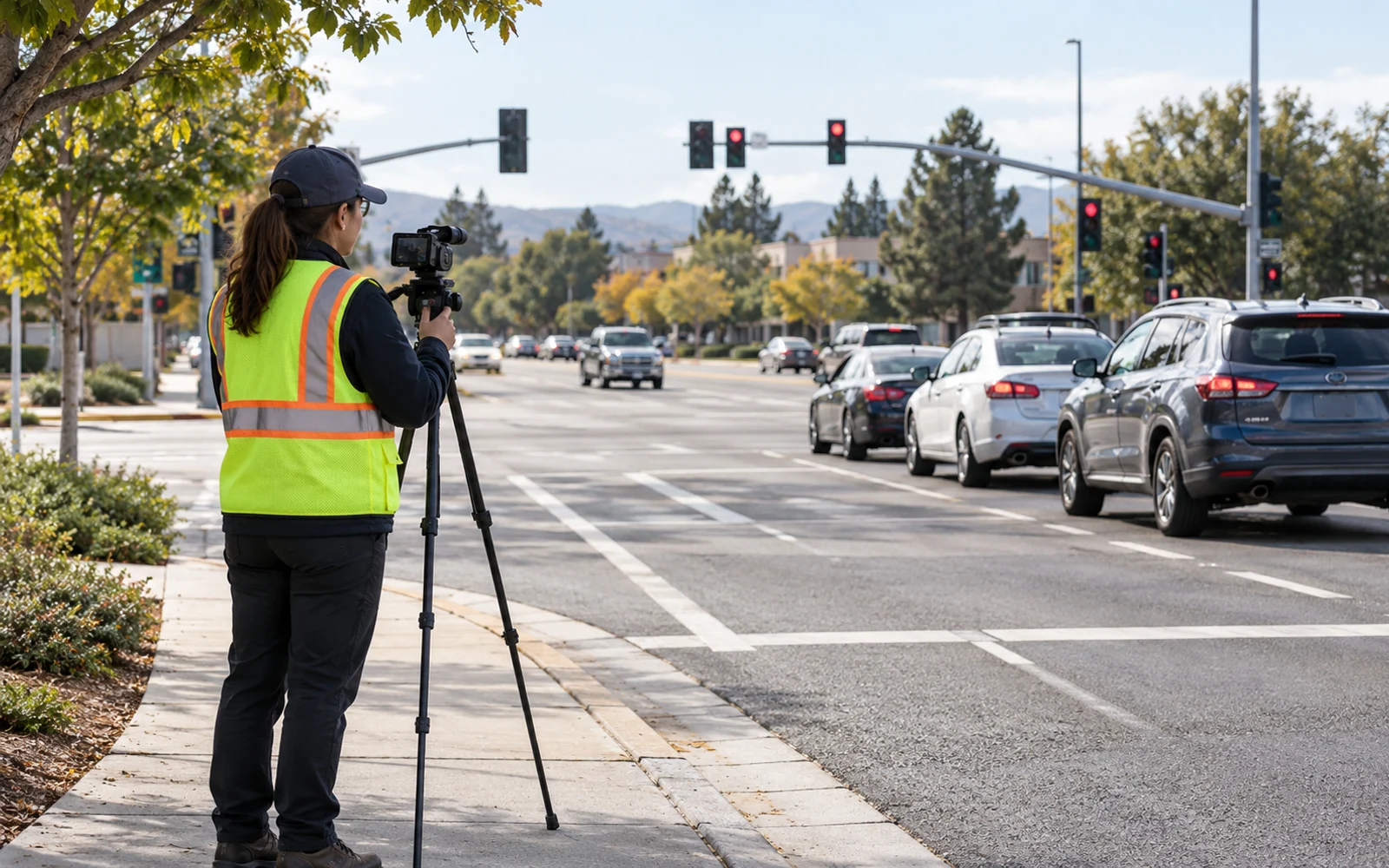
Review occlusion, track fragmentation, stopped vehicles, large vehicles obscuring others and movements crossing camera boundaries. Keep a sample of ordinary observations as well as obvious errors so the review does not inspect only difficult cases.
Distinguish a missing track from an uncertain turn. If the count is known but its movement is unresolved, the approach total and turn totals carry different confidence. An “unknown movement” bucket is more honest than forcing every vehicle into left, through or right.
Compare reconciled movement totals with an independent approach count over the same boundary and interval. Investigate differences, but do not alter observations merely to make totals match. For classification-specific errors, use the separate vehicle-classification accuracy method.
Any manual correction should retain the original record, the revised interpretation and a reason. If a missing interval is estimated, label it as estimated and describe the method; do not merge it invisibly into observed counts.
Deliver counts with a usable audit trail
Provide the movement dictionary, interval table, observation coverage, unresolved records, queue context and correction history. Note unusual conditions such as road works, incidents or an atypical operating day without declaring the dataset representative of a whole season.
Preserve the survey geometry, movement definitions and event records with the count table. A later analyst should be able to distinguish observed movements, inferred demand and unavailable observations.
FAQs
What should a turning movement count include?
Include approach and exit definitions, left/through/right and any separately defined U-turn movements, observation intervals, road-user classes, coverage and quality flags. Add the context required by the study, such as queues and pedestrian or bicycle movements.
Are intersection departures the same as arrival demand?
Not when queues grow or shrink. Under a defined boundary without other entries or exits, arrivals equal departures plus the change in queue accumulation. Congested studies must account for unmet demand rather than using departures alone.
How should a partially occluded vehicle be counted?
Retain an unresolved or ambiguous record when the movement cannot be established. Do not force it into the most common turn. Use independent review or a documented estimation method, keeping estimates separate from observed counts.