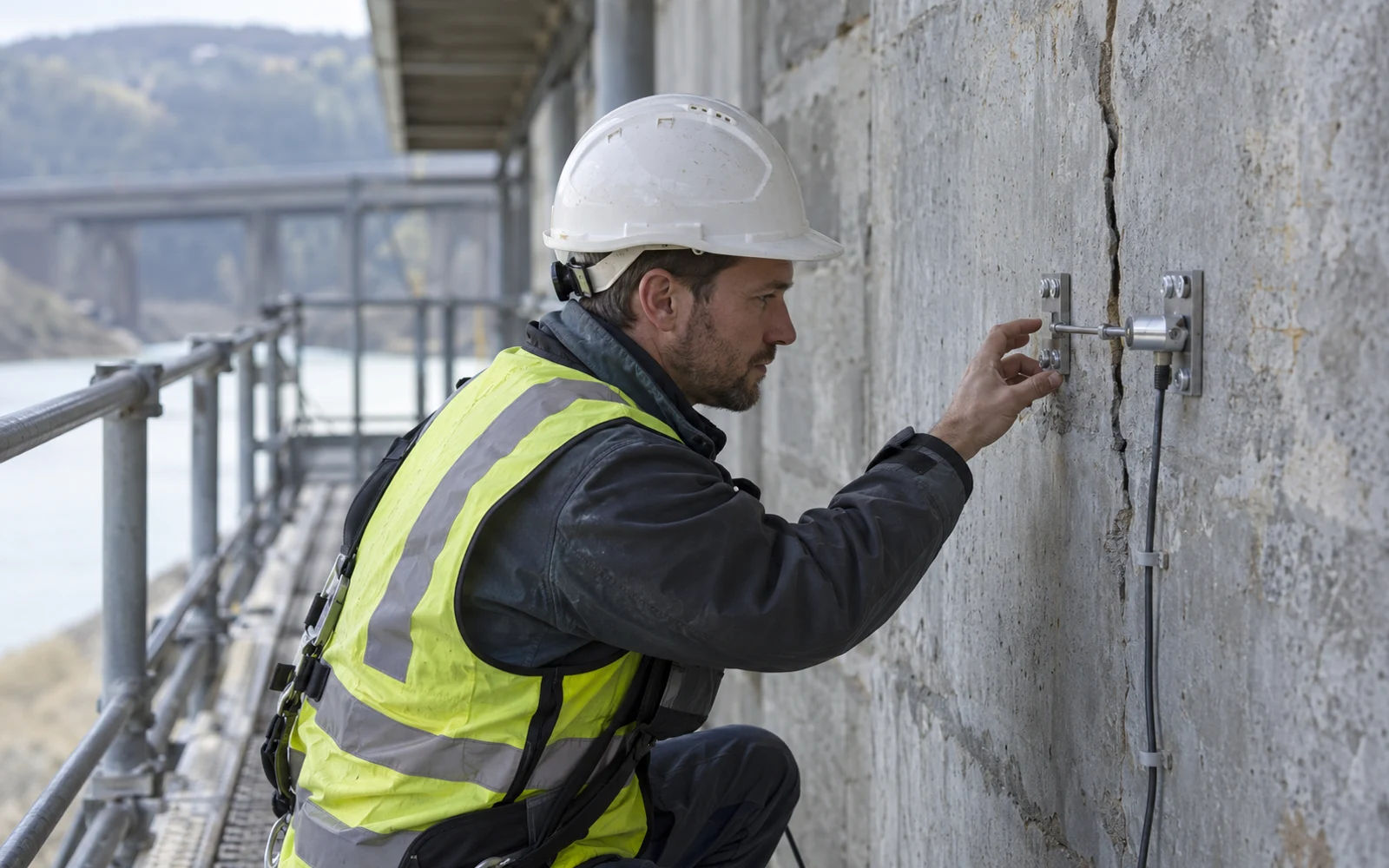
A crackmeter reading can change because the structure moves, the instrument responds to temperature, or the installation changes. Temperature correction of the sensor does not remove the structure's real thermal movement. Keep those layers separate before deciding what a trend means.
Table of Contents
Why can a crack reading change with temperature?
Both the instrument and the monitored material can respond to temperature. A reported displacement may therefore contain an instrument-related contribution alongside real movement between its anchors. The relevant temperature may also differ from air temperature at a distant weather station.
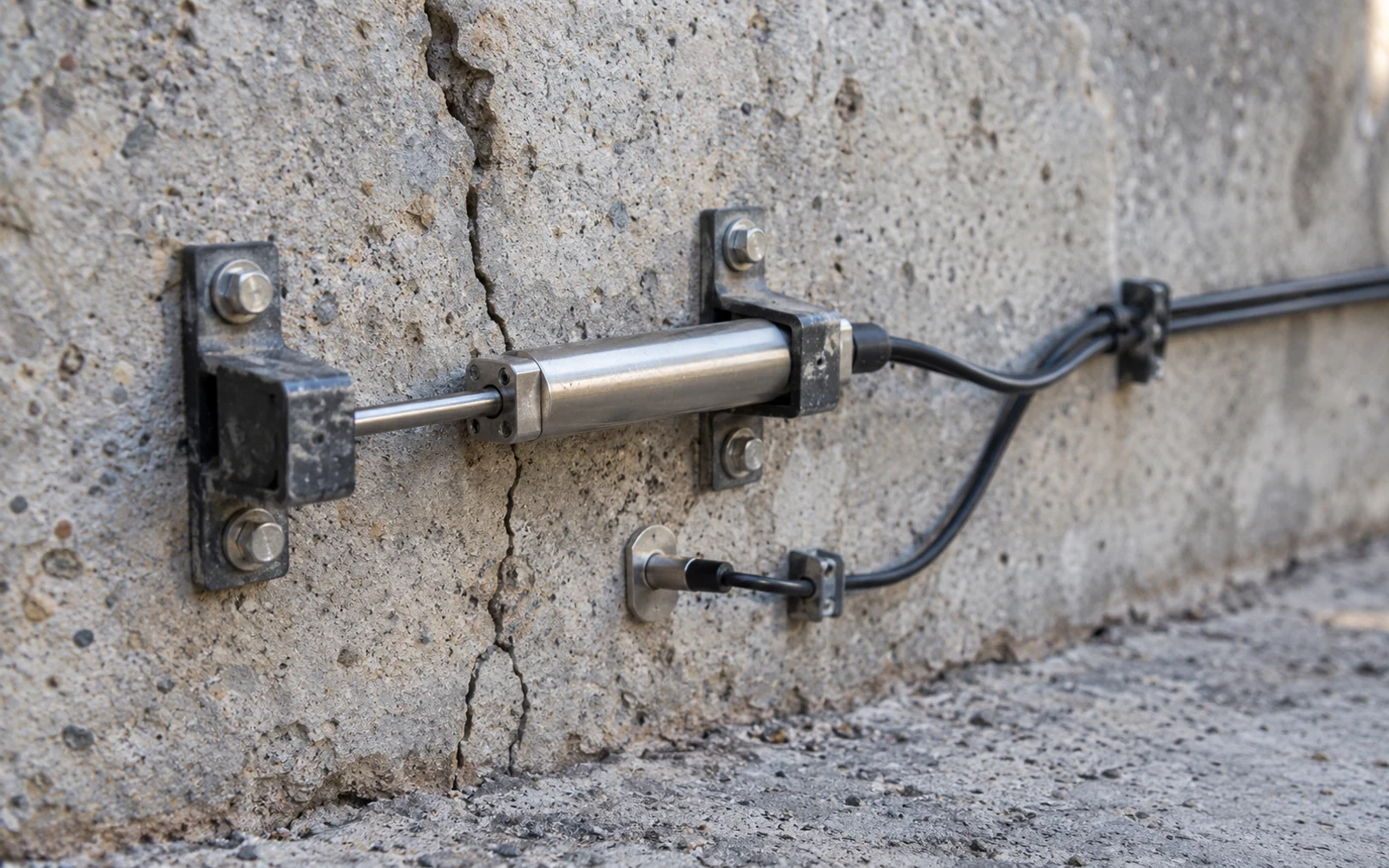
A crackmeter measures the change associated with its installed axis and mounting arrangement. It does not directly identify the cause of a crack, the depth of damage or the remaining capacity of a structure. Those are interpretation questions that require additional evidence.
The GEOKON crackmeter data-reduction guidance distinguishes instrument correction from thermal behavior of the attached material. It also makes the instrument’s calibration factors explicit. Use the documentation for the actual sensor rather than a universal “temperature compensation” setting.
Separate three layers of interpretation
First retain the raw observation: the instrument output, measured temperature, timestamp and quality state. Then derive displacement using the applicable calibration, including an instrument correction if required by the method. Finally assess the engineering behavior of the monitored material.
These are different layers, and each should remain recoverable. A plot labeled only “corrected crack width” hides whether correction means conversion to engineering units, sensor temperature treatment or removal of an empirical relationship with temperature.
| Layer | Question it answers | What must remain visible |
|---|---|---|
| Raw observation | What did the instrument report? | Original output, time, temperature and quality flags |
| Instrument reduction | What displacement does the calibration imply? | Factors, units, reference reading and correction version |
| Structural interpretation | What may explain the observed movement? | Environmental context, loading, assumptions and unresolved behavior |
A useful naming convention distinguishes “instrument-corrected displacement” from “modeled residual.” The latter is the difference from an explanatory model; it is not a new direct measurement.
The bridge-monitoring design guide addresses the wider selection of measurements. Here, the immediate task is to preserve the meaning of one movement series while applying necessary corrections.
A paired observation record
Record displacement and relevant temperature on a compatible time basis. Add site events that could explain discontinuities: maintenance, anchor disturbance, construction activity, impact, rainfall or a changed monitoring configuration. A spreadsheet of dates and displacement alone leaves too many interpretations open.
The original field record should identify the instrument, orientation and reference reading. For a later reprocessing run, record why the calculation changed and which portion of the history it affects. A new formula should not overwrite the only historical series.
Consider an illustrative pattern: morning readings cluster at one level, afternoon readings at another, and the pattern repeats. This suggests investigating a relationship with thermal conditions; it does not prove temperature is the sole cause. Compare similar conditions over time and investigate whether load, solar exposure or another recurring activity also changes.
Beware of removing the signal you need
A fitted relationship can absorb gradual structural change if the model is continually retrained on the same changing data. Before using a residual for monitoring, define the training period, applicable conditions, validation method and what happens outside that range.
Likewise, a simple air-temperature correction may be inadequate when the structure warms and cools with delay or experiences different sun exposure. Treat unexplained residuals as unresolved observations, not as permission to invent additional correction terms until the trend disappears.
When should the team escalate a residual trend?
Escalate according to the asset-specific monitoring and response plan when a credible observation exceeds its agreed criteria, when an unexpected pattern persists, or when data quality prevents the intended assessment.
Review the raw and reduced series, mounting condition, temperature channel and independent observations. An apparent jump immediately after maintenance needs investigation, but should not be dismissed solely because maintenance occurred. Record the outcome and retain the evidence that supported it.
For response ownership and degraded-data handling, connect the observation to the monitoring alarm workflow. A correction model should never silently suppress an event that the site’s approved process requires staff to review.
Keep corrections reversible
Deliver the original data, calibration record, instrument-corrected output, any model-derived series and a concise explanation of their differences. Confirm that the person viewing the dashboard can identify which series is displayed.
Keep raw crack observations and the temperature-adjusted series together in the handover. Their relationship helps the next engineer distinguish the fitted thermal response from movement that still needs investigation.
FAQs
Should all temperature-related crack movement be removed?
No. Instrument temperature effects and real movement of the monitored material are different. Structural thermal movement can be relevant evidence and should not be erased merely because it correlates with temperature.
Can one crackmeter coefficient be used for every sensor?
No. Apply the actual sensor's calibration and temperature-correction method. The coefficient may depend on its model, configuration and measurement state; do not borrow it from another installation.
Does a widening crack automatically show imminent failure?
A displacement reading alone does not establish structural cause or remaining capacity. Unexpected change should be escalated through the asset's agreed engineering and safety response process.