Drone dock installation is a permanent site decision, so its budget must cover power, communications, landing access and recovery. Select the location before freezing the hardware order: a reachable charging enclosure can still be unusable for the intended inspection route.
Table of Contents
The enclosure is only one part of the site
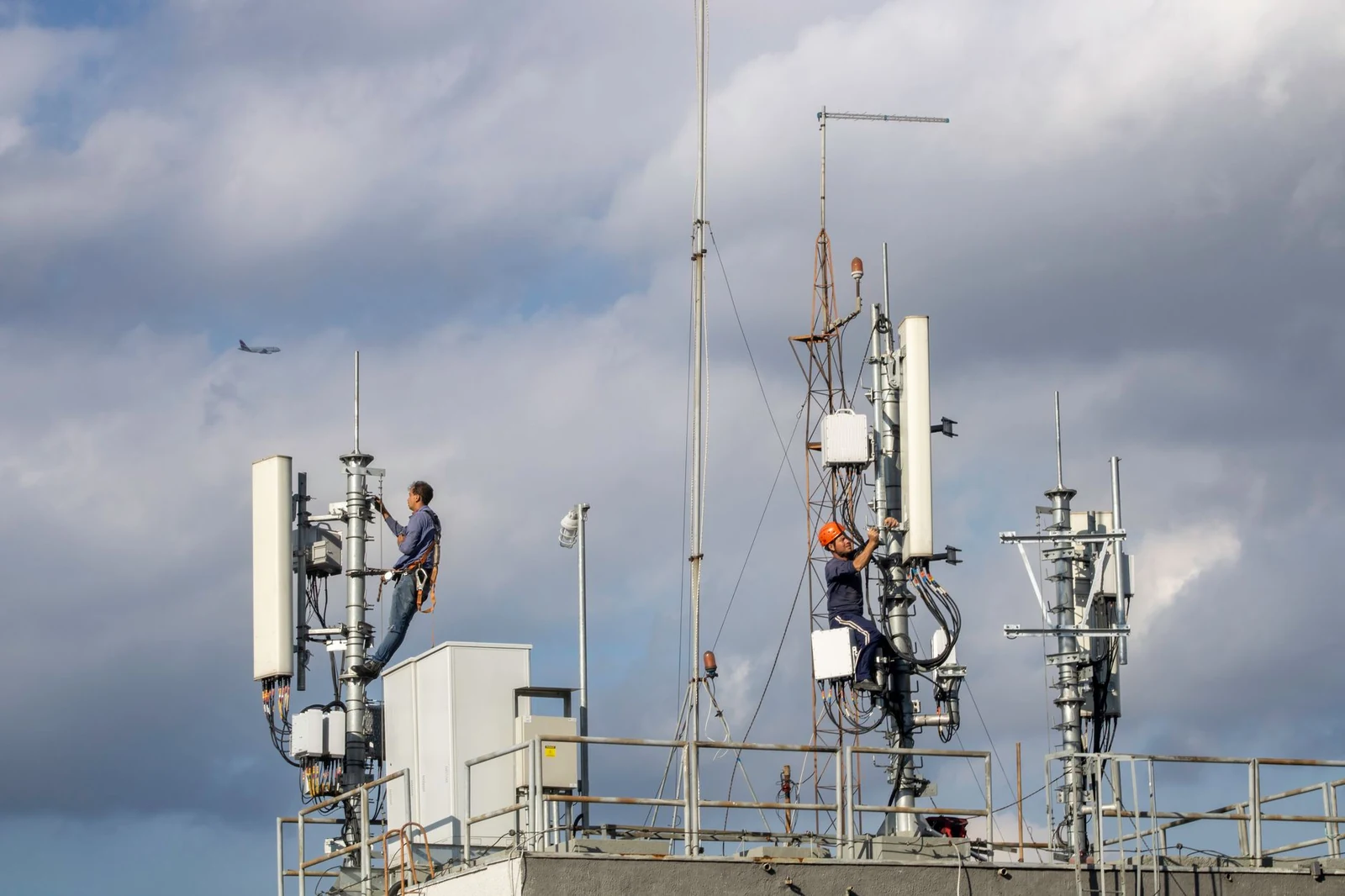
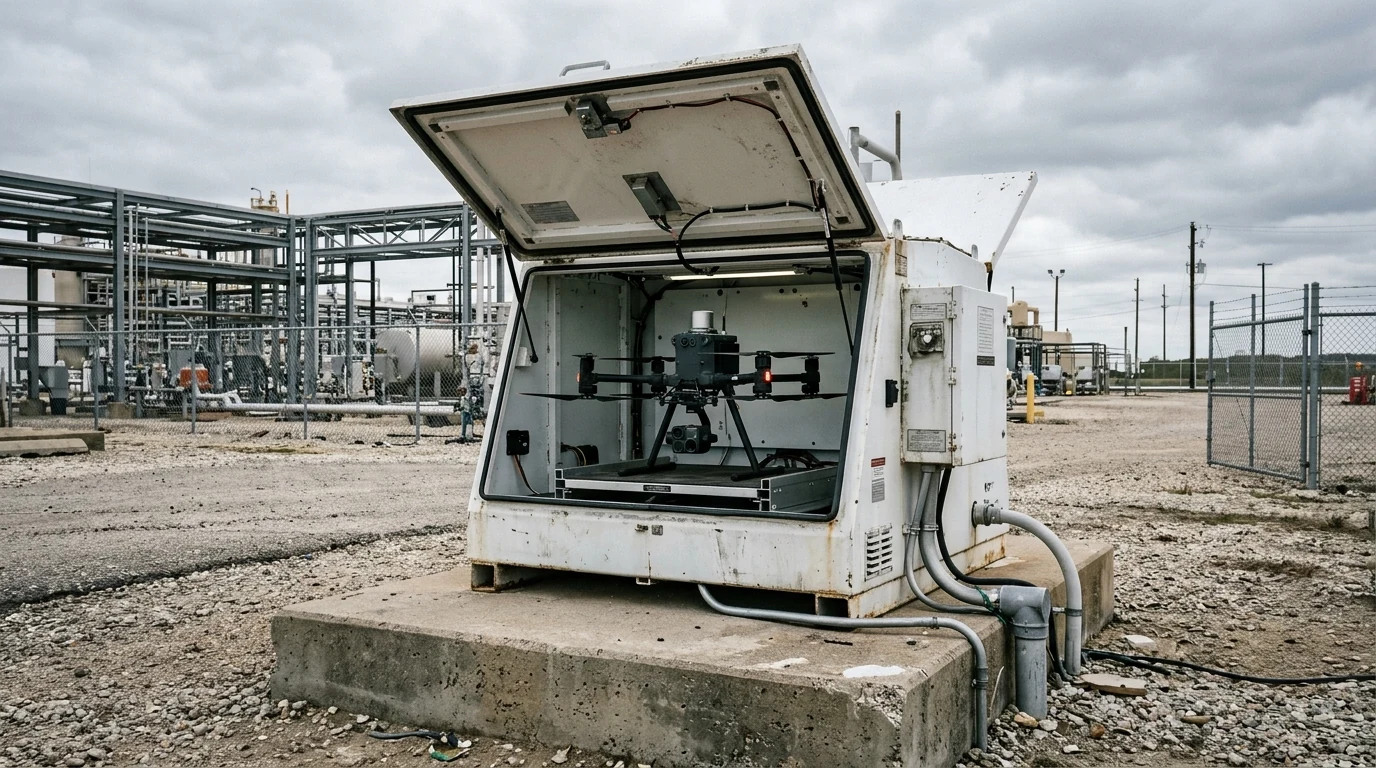
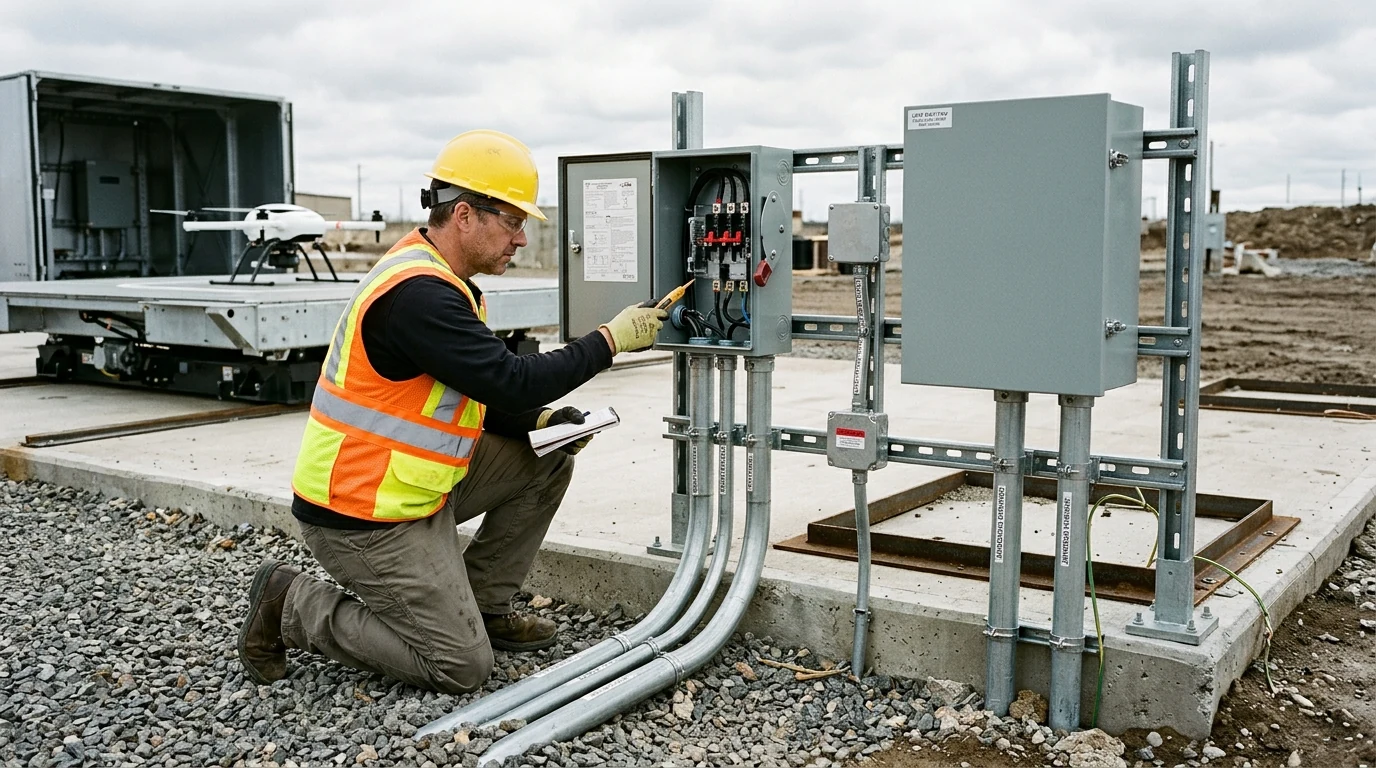
A useful site drawing includes the dock, its open-cover envelope, access for maintenance, the launch and approach space, cable routes and an alternate recovery location. The best roof for radio coverage can be the worst place to replace a failed component. A convenient ground location can introduce vehicle movements or public access into the landing area.
The DJI Dock 3 installation FAQ illustrates how specific these constraints are: it calls for an open environment with stable power and internet, and limits compatibility to the Matrice 4D series. Treat those as requirements of that particular ecosystem. A generic “drone in a box” label does not establish compatibility with another aircraft.
For an industrial UAV project, separate the aircraft selection from the decision to automate its launch and servicing. A dock only creates value if the inspection output is still useful when a remote operator cannot adjust the camera or landing area in person.
Survey the site before the quote
A useful survey records the dock footprint, open-cover envelope, maintenance access, launch and approach clearance, cable routes, power and network sources, drainage, wind exposure, public or vehicle access, and the alternate recovery location. Photograph the actual conditions. The survey should identify which services the site owner supplies and which remain with the supplier.
Which services must survive an outage?
Specify the required state of each function during a power or network failure. “Four hours of backup” is incomplete unless it says whether the system can communicate, open its cover, manage temperature, charge the aircraft and support recovery.
DJI’s Dock 3 specifications state that its backup supply does not support aircraft charging, air conditioning and certain heating functions after mains failure. The purchasing implication is to distinguish a protected shutdown or recovery function from continued mission throughput.
| Site condition | Function to preserve | Consequence for the installation |
|---|---|---|
| Short mains interruption | Defined safe equipment state and status reporting | Size backup for the protected loads |
| Extended utility outage | Recovery access and restart procedure | Assign a local response owner |
| Internet unavailable | Documented aircraft and dock behavior | Test the installed control architecture |
| Landing area obstructed | Safe alternate recovery | Keep the alternate site accessible |
| Maintenance visit | Isolation and physical access | Include service space and access permissions |
An independent internet subscription does not make two links independent if both use the same router or power supply. The UAV communications architecture guide develops that common-failure problem at route level.
Budget the cycle, not just the flight
The interval between inspections includes outbound flight, data collection, return, landing, charging, thermal conditioning and any preparation before the next launch. A maximum flight-time claim therefore cannot determine hourly inspection capacity.
For an illustrative schedule, assume a 20-minute flight, 30 minutes of turnaround and 10 minutes of operational allowance. That is a 60-minute cycle, or at most one planned mission per hour before weather closures and maintenance. If the inspection requires a second flight, the revisit interval changes even though the aircraft has not changed.
Use the expected seasonal conditions to build a schedule with unavailable periods. A site that needs inspection immediately after severe weather also needs a recovery plan for the period when the aircraft is outside its operating envelope.
Put site work into the purchase boundary
Split the quote into dock and aircraft, electrical installation, communications, foundations or mounting, commissioning, and recurring service. Each boundary should identify who supplies the item and who restores it after failure. Grounding and electrical protection belong in a qualified installation design using the exact manufacturer’s instructions and local requirements.
In a critical infrastructure inspection program, agree on an accepted output, such as usable images of specified assets, rather than a count of autonomous launches. A dock that launches reliably but returns unusable data has not met the requirement.
A sensible first order covers one representative location. Expansion follows when the complete cycle—inspection, upload, review, charging and recovery—works under that site’s conditions. Keep the site drawing, service responsibilities and accepted output in the project resources so the next location can be compared on the same basis.
FAQs
Can a dock backup battery recharge the aircraft?
That depends on the dock. DJI lists functions that its Dock 3 backup battery does not power, including aircraft charging. Specify which functions must survive an outage instead of treating backup duration as flight availability.
Can a dock be moved after commissioning?
A move changes the landing reference, surrounding obstacles, network path and recovery arrangements. Treat relocation as a site configuration change and repeat the affected installation checks.
Should network service be included in the dock quote?
Yes, or assigned explicitly to the buyer. The scope should include the connection, service charges, routing, support ownership and behavior when the connection fails.
Can an existing roof or parking structure support a dock?
Only after a structural and access assessment. The dock, its open cover, maintenance load and cable route add point loads and working space; the building owner must confirm structural capacity, waterproofing, fall protection and permitted access.