A BVLOS drone communication system should not be selected by maximum range or peak data rate. It must keep safety-critical command and control distinct from payload traffic, define service along the real route, manage independent backup paths, secure every trust boundary and produce safe aircraft behavior when links degrade.
Table of Contents
- Separate C2, Telemetry, Payload Data, and Identification Services
- Convert the Route Into Availability, Latency, and Integrity Requirements
- Compare RF, Cellular, Satellite, and Mesh Links by Failure Mode
- Build Multi-Link Routing Without Creating Hidden Common Failures
- Control Spectrum, Interference, Identity, Encryption, and Updates
- Define Degraded-Link and Lost-Link Aircraft Behavior
- Accept Communications Along the Real Route and at the Network Edge
- FAQs
Separate C2, Telemetry, Payload Data, and Identification Services
Inventory communication services before choosing radios. Command and control carries operator commands and aircraft state needed for safe flight. Telemetry may overlap with C2 but can also feed maintenance or mission systems. Payload data includes video, imagery and sensor products. Identification and tracking services, including Remote ID where applicable, serve another purpose.
Give every service an owner, direction, data rate, latency, integrity, availability, confidentiality and logging requirement. Define which service may be reduced or delayed first. A video stream should not consume capacity needed to deliver a control command or health warning.
The U.S. GAO’s 2026 technology assessment on how drones will communicate and avoid other aircraft describes the broader coordination challenge. It should not be read as proof that one nationwide communications method is already available for every operation.
Convert the Route Into Availability, Latency, and Integrity Requirements
Divide the route into mission phases and geographic cells. For each, record terrain, altitude, population or infrastructure, alternate landing areas, external network coverage, interference and the maximum time a service can be unavailable. Give critical thresholds to the operations and safety teams, not only the network designer.
Availability is more than signal bars. Measure successful bidirectional transactions, latency distribution, packet loss, stale telemetry, link-state accuracy and recovery time. For critical commands, include integrity and authentication failures. A link may show high received power while its backhaul or core service is unavailable.
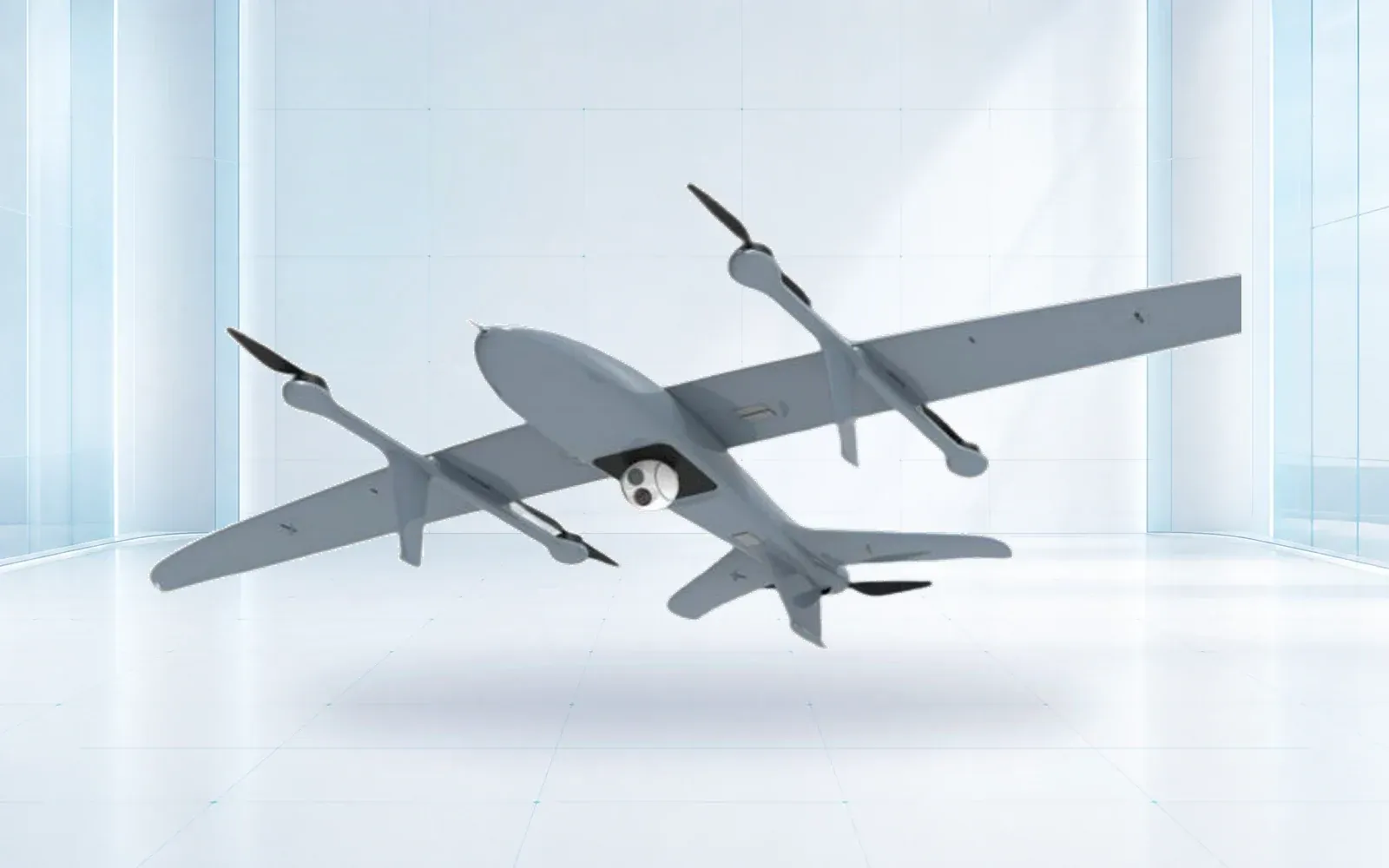
The industrial UAV datasheet guide explains why aircraft range belongs to the communications architecture. The ZJ-G20 and ZJ-G25 are route-aircraft references whose exact link options must be verified in the offered configuration.
Compare RF, Cellular, Satellite, and Mesh Links by Failure Mode
| Link type | Coverage dependency | Useful role | Failure question to answer |
|---|---|---|---|
| Direct point-to-point RF | Antenna geometry, terrain, interference and spectrum | Controlled primary or local backup path | What happens below line of sight or near the RF noise floor? |
| Private LTE or 5G | Designed radio sites, core, power and backhaul | Managed corridor or site network | Are radio, core and backhaul failures independent? |
| Public cellular | Operator aerial coverage, capacity, roaming and policy | Wide-area bearer without owned towers | What happens at handovers, congestion and commercial outage? |
| Satellite | Sky view, terminal, constellation and gateway | Remote-area alternate or primary path | How do blockage, latency, service region and terminal heat affect C2? |
| Aerial or ground mesh | Relay position, routing, spectrum and node health | Extend around terrain or damaged infrastructure | Can one node or route change isolate several aircraft? |
Compare normal and failure states, not only peak throughput. Also price data plans, private infrastructure, licenses, antennas, installation, monitoring, support and test flights across the full operating life.
Build Multi-Link Routing Without Creating Hidden Common Failures
Two links are not independent if they share the same modem, antenna, power rail, processor, SIM provider, identity server, backhaul or software router. Draw the physical and logical paths from operator to aircraft and mark common components.

Define whether links are active-active, active-standby or selected by phase. Specify health checks, switching thresholds, dwell time, route policy and what happens to in-flight commands during a switch. Prevent oscillation between marginal links, and preserve a log that explains every routing decision.
The U.S. DOT’s public record for a UAS communication mesh test deployment is useful engineering context: mesh performance must be evaluated as a deployed network rather than a product label.
Control Spectrum, Interference, Identity, Encryption, and Updates
Confirm permitted frequencies, power, channel use, equipment authorization and operator licensing in every jurisdiction. Survey expected interference and define coordination around airports, public-safety systems, industrial radios and events. A frequency available in one market may be unavailable or constrained in another.
Authenticate aircraft, ground station, relay and service endpoints. Protect control confidentiality and integrity, manage keys, rotate credentials and define recovery after a device is lost. Separate maintenance access from flight operations and record configuration changes.
ETSI publishes Release 19 specifications including TS 23.256 for UAS connectivity, identification and tracking. A standards-defined architecture does not guarantee that every carrier, device or region has implemented every function; procurement must request interoperable evidence for the actual network.
Define Degraded-Link and Lost-Link Aircraft Behavior
Create states for high latency, reduced bandwidth, one-way traffic, unreliable navigation, primary-link loss, all external links lost and link recovery. State aircraft route, speed, altitude, payload behavior, geofence and landing logic for each state.
The safe response depends on the route. Returning may cross a hazard or enter a communications shadow again. Holding may consume reserve or conflict with other aircraft. Landing may be unsafe outside prepared sites. Approve behaviors by geographic segment and include remaining navigation integrity and energy in the decision.
Show the operator which service is degraded and whether commands are confirmed. Never present stale aircraft position as live. Define how the remote pilot can override an automatic action when a verified alternate link remains available.
Accept Communications Along the Real Route and at the Network Edge
Instrument the aircraft, ground station and network. Fly each route cell in both directions, at relevant altitude and orientation, with representative payload traffic. Test handovers, congestion, terrain shadow, relay loss, backhaul outage, authentication failure, stale telemetry and complete lost-link behavior under an approved safety plan.
Measure availability by service, latency distribution, loss bursts, command confirmation, state-detection time, switching time, false link-state indications, data recovery and aircraft response. Preserve raw network and flight logs with synchronized clocks.
Repeat after material changes to radios, antennas, carriers, routing, firmware, terrain infrastructure or flight profile. Use the border security, oil and gas and emergency response solution contexts to build realistic routes. For a route service-level and failure test, contact OMNI UXV with the operation, bearer options, network map and approved aircraft contingencies.
FAQs
What is the difference between a drone C2 link and a video link?
C2 carries safety-critical commands and status needed to manage the aircraft, while video is payload data that usually needs more bandwidth but may tolerate loss or delay differently. Their priorities, security, monitoring and degraded states should be specified separately.
Is cellular connectivity enough for BVLOS drone operations?
Cellular can be useful where aerial coverage, capacity, roaming, latency, authentication and backhaul meet the operation's needs. It should not be assumed continuous, and a safety case may require another bearer or defined aircraft behavior at coverage gaps.
How does a drone mesh network improve coverage?
A mesh can relay around terrain or extend a route through other nodes, but it adds routing, capacity, synchronization, interference and dependency questions. The relay path and its failure behavior must be tested, not inferred from node count.
What should happen when the primary C2 link fails?
The aircraft should enter a pre-authorized state based on position, remaining navigation integrity, traffic and landing options. That may involve switching links, limiting the payload, holding, rerouting, returning or landing; one default action is not safe for every route.