A mapping flight can meet its planned altitude and overlap yet return unusable imagery because the ground moves too far across the sensor during each exposure. A simple blur budget connects ground speed, exposure time and GSD, then field images reveal the effects that the calculation leaves out.
Table of Contents
How much motion fits inside one pixel?
For a nadir camera translating over level ground, approximate blur as b = v × t / g. Here b is blur in pixels, v is ground speed in metres per second, t is exposure time in seconds and g is GSD in metres per pixel.
At 8 m/s and 0.02 m/pixel, an exposure of 1/500 s produces a translational estimate of 0.8 pixel. At 1/1000 s it becomes 0.4 pixel. If a project chooses a planning allowance of 0.5 pixel, the corresponding exposure limit is 0.00125 s, or 1/800 s. That allowance is an illustrative design choice, not an industry-wide acceptance threshold.
| Change in the example | Estimated blur | Practical implication |
|---|---|---|
| 8 m/s, 1/500 s, 2 cm GSD | 0.8 pixel | Inspect whether edge detail remains usable |
| 8 m/s, 1/1000 s, 2 cm GSD | 0.4 pixel | Less translation during the exposure |
| 12 m/s, 1/1000 s, 2 cm GSD | 0.6 pixel | A faster pass consumes the blur allowance |
| 8 m/s, 1/1000 s, 1 cm GSD | 0.8 pixel | Finer sampling makes the same motion more visible |
Use ground speed rather than an assumed airspeed. Wind can change the speed over the target. The GSD planning guide supplies the geometry used in the denominator.
Why are blur and rolling shutter different?
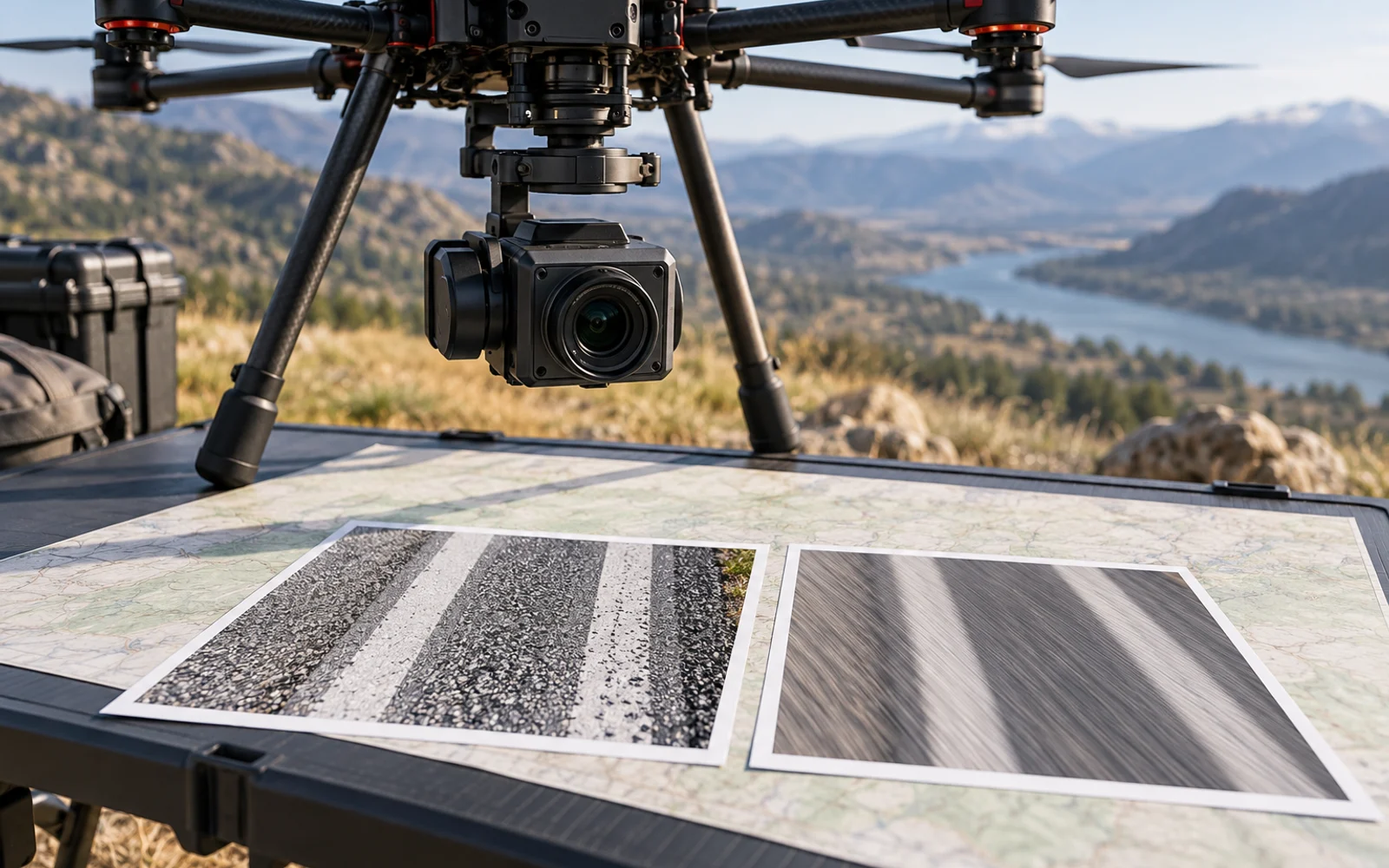
Exposure blur accumulates while a pixel gathers light. Rolling-shutter distortion arises because different sensor rows represent different moments. A short exposure may reduce smear while line-by-line readout still bends the reconstructed geometry.
Pix4D documents the rolling-shutter effect and a software-specific correction workflow. Its existence should not be interpreted as a guarantee that any moving-camera image can be repaired. Confirm camera support, orientation and processing settings for the selected software.
Rotation, vibration, focus errors and atmospheric haze are outside the simple translation formula. A gimbal can help stabilize viewing direction but cannot stop the aircraft’s translation over the ground.
Build an exposure budget for the darkest usable conditions
Choose the expected GSD range and maximum acquisition speed first. Calculate a candidate exposure limit, then test whether the lens aperture, ISO and available illumination provide adequate signal at that exposure.
Do not copy settings from a bright demonstration flight into a shaded industrial site. A camera that automatically slows its shutter under cloud can cross the blur budget without changing the flight plan. Retain exposure metadata so the affected images can be located.
Slowing the aircraft may preserve both sharpness and noise performance, but changes mission duration, turns and energy use. Review those effects with the endurance planning method. Evaluate an approved alternative capture configuration when the required detail cannot be obtained within the operating envelope.
What should the crew inspect before leaving?
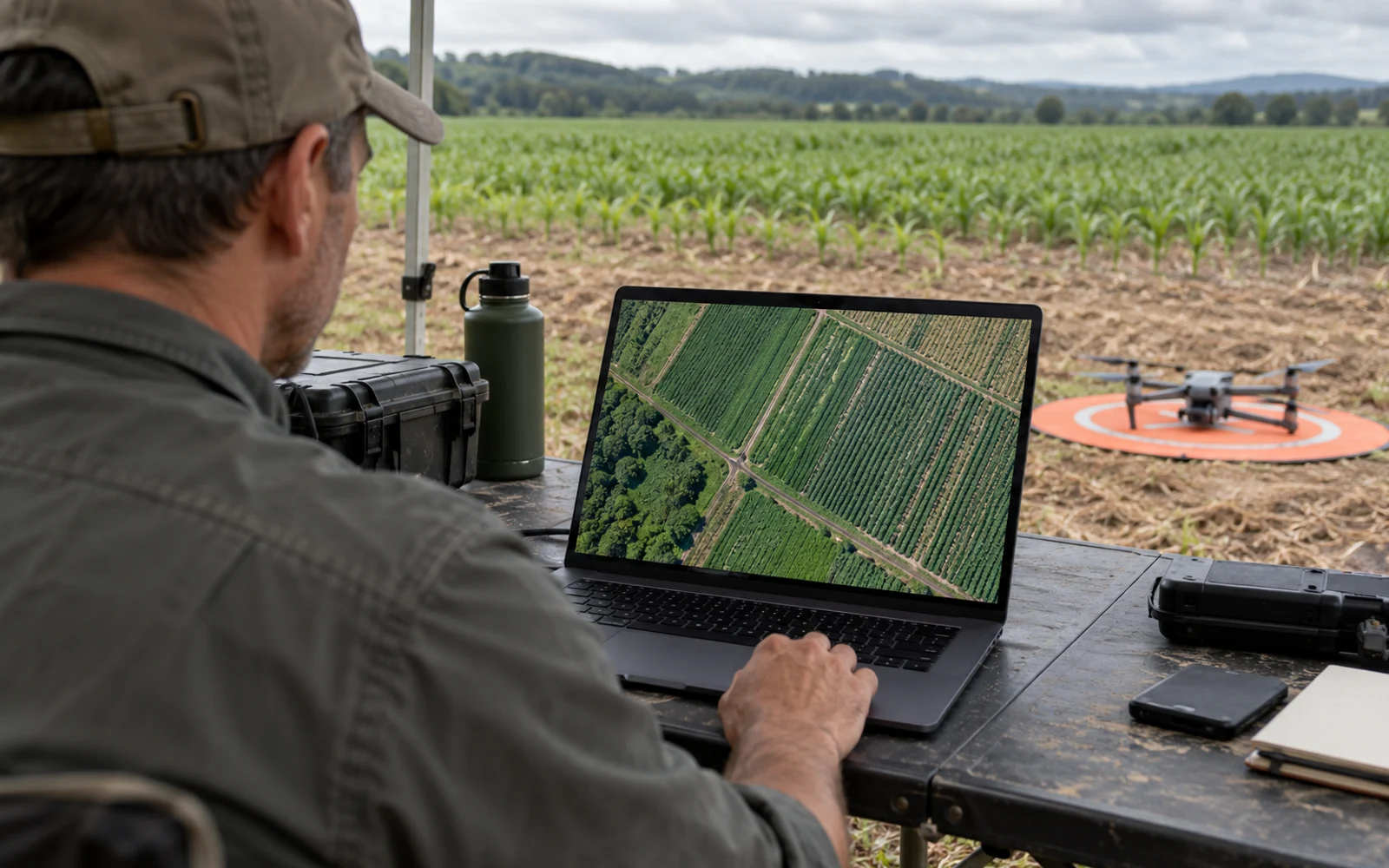
Review original images from the fastest straight segment, turns if they are used in reconstruction, the darkest surface and the largest camera-to-ground distance. Look at fine edges in both image directions, not only a downsampled preview.
Distinguish directional smear from defocus: repeated aligned streaking suggests motion, while broadly soft edges can have another cause. Compare metadata and adjacent images. Confirm that acceptable images still provide the required overlap after rejected exposures are removed.
Write down the rejection rule before the flight. It can refer to a representative target or a defined feature-visibility task. A general statement that images “look sharp” is difficult to reproduce between operators.
Connect sharp images to usable mapping
Deliver an exception map and acquisition log alongside the reconstructed product. Identify where blur, shadow, noise or incomplete coverage limits interpretation. A visually smooth mosaic should not conceal source-image weaknesses.
For precision agriculture, preserve the capture settings needed to compare fields and dates; the agricultural data-quality article covers those additional dependencies. A representative capture trial should establish which exposure and flight-speed combinations retain the required detail.
FAQs
How can motion blur be estimated in pixels?
For simple nadir translation, divide ground speed multiplied by exposure time by GSD in matching units. Rotation and vibration require additional checks.
Does rolling-shutter correction remove exposure blur?
No. Rolling-shutter processing addresses geometric distortion from line-by-line readout. It does not recreate detail smeared within an exposure.
Is the shortest shutter time always best for mapping?
No. Short exposure reduces translational smear but can require settings that increase noise or underexposure. Check the complete camera and lighting combination.