Micro-Doppler reveals motion within a radar target, including rotor or wing movement. A classifier can use those patterns alongside other observations, with useful performance determined by the target classes, recording conditions and independent test data.
Table of Contents
What does micro-Doppler add to a radar track?
Micro-Doppler describes additional frequency variation caused by motion within a target, rather than only the motion of the target as a whole. Rotating blades and flapping wings can contribute such information.
MathWorks’ technical introduction illustrates how rotating or swinging parts add Doppler components. Its examples explain the principle through simulation; they do not demonstrate the performance of an installed civil drone detector.
A track and a class label answer different questions. A track estimates the evolving location or motion of an object. A classifier interprets features to assign a category. A stable track may remain unclassified, and a label without a reliable association to the correct track may be operationally unhelpful.
Read the experiment behind the accuracy number
Begin with class definitions and the unit being scored. Is the result calculated per spectrogram image, observation window, flight, track or incident? Thousands of windows from a small number of flights do not represent thousands of independent operating situations.
In their 2020 original study, Rahman and Robertson examined both two-class and four-class formulations using radar micro-Doppler images. The paper describes the radar bands, target set and data diversity. Changing the class problem changes what an accuracy percentage means.
For a procurement review, request the actual test population, class balance, held-out procedure and confusion matrix. As an editorial recommendation, group related observations from the same trial when separating training and evaluation data, so near-duplicate windows do not make generalization appear stronger than it is.
Identify conditions absent from the evidence. A result on known target types in one collection campaign should be described within that boundary. Do not fill the gap with an unsupported claim about every bird, drone, location or season.
A classifier evidence matrix
Use this recommended matrix to convert a model presentation into questions that an evaluator can verify.
| Evidence item | Review question | Decision it supports |
|---|---|---|
| Dataset inventory | Which target classes and observation conditions are represented? | Whether the proposed use lies inside the tested scope |
| Split definition | Are related tracks or trials kept from leaking across evaluation boundaries? | Credibility of the generalization claim |
| Confusion matrix | Which classes are confused, and how often within the sample? | Consequences of errors, not just average accuracy |
| Scoring unit | Is a window, track or incident counted? | Comparable metrics across suppliers |
| Decision timing | When is a label available and when does it change? | Usefulness within the operator workflow |
| Unknown policy | What happens when evidence is insufficient? | Safe handling of ambiguity |
| Version record | Which model, thresholds and preprocessing produced the output? | Reproducibility and regression review |
Preserve ground truth and include non-drone observations so the evaluation measures both target recognition and mistaken classifications.
Why must unknown remain a valid output?
A classifier cannot establish a reliable identity merely because its interface requires one of two buttons. An unknown, ambiguous or insufficient-evidence state allows the system to communicate a limitation instead of concealing it.
Define what the confidence value means. A model score is not automatically a calibrated probability of an operational event. Request evidence of calibration if the interface presents it that way. Establish how conflicting or changing labels are retained, and avoid rewriting the earlier history to show only the final confident output.
Score abstention separately from correct and incorrect classification. Also examine whether an unresolved observation persists long enough to affect an operational decision. The counter-UAS false-alarm guide covers site-level alert burden; classifier performance is one input to that wider assessment.
Join classification to the operator workflow
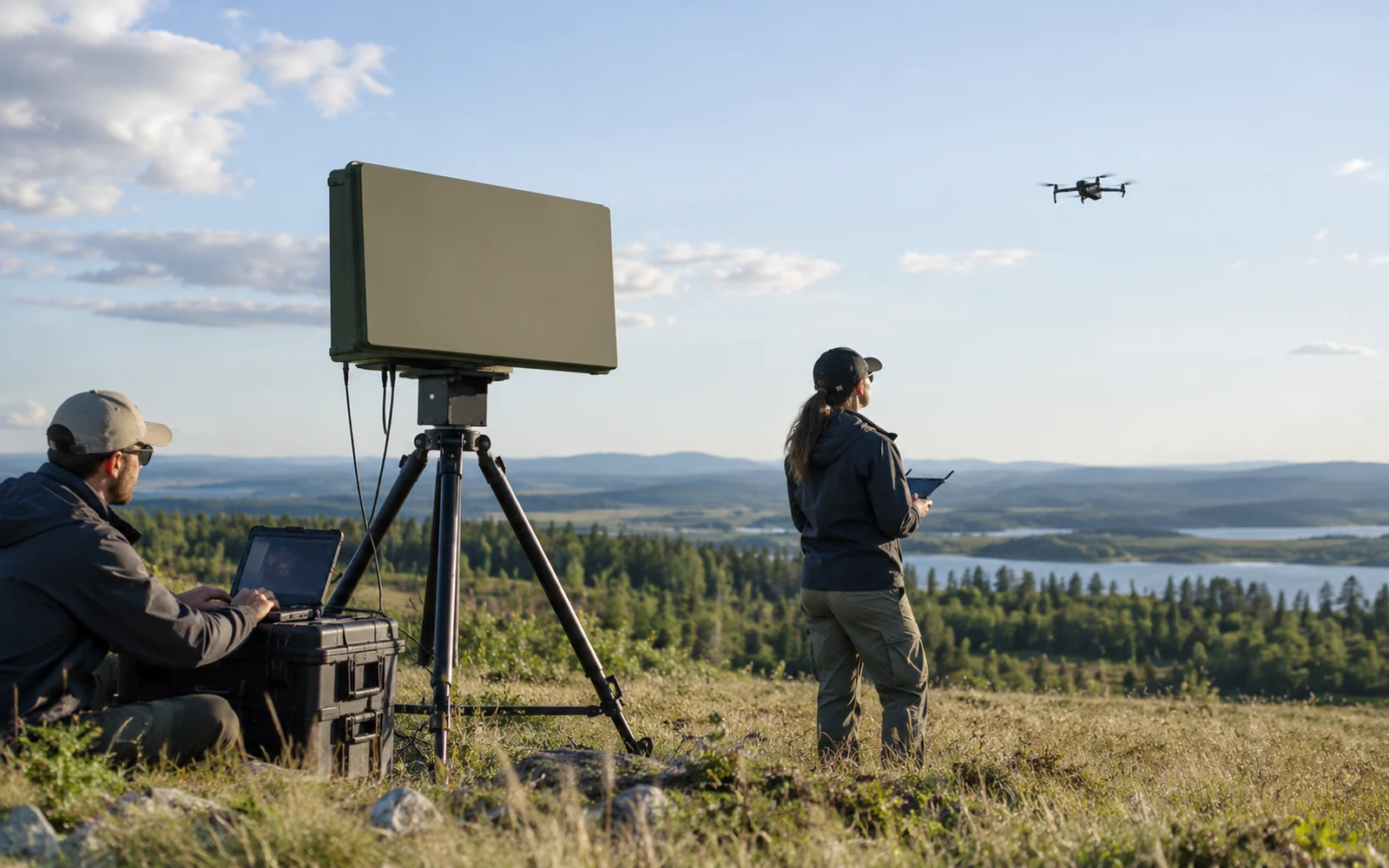
For a civil counter-UAS system, specify how a class label is associated with a track, shown to an operator and corroborated through an appropriate second source. Preserve timestamps, model version and the supporting observation window.
The classification result should state the tested target classes, recording conditions and error distribution. Those details determine how an operator can use the micro-Doppler label and which observations require another sensor.
FAQs
What does micro-Doppler reveal about a drone?
It can reveal additional Doppler variation associated with moving parts such as rotating blades. Those patterns may help classification, but their usefulness depends on observation conditions, signal quality and the validated processing method.
Can a research paper's classification accuracy be used in an RFP?
It can motivate an evaluation question, but it should not be adopted as a supplier performance claim. The dataset, class definitions, test split, radar configuration and scoring unit must match the claim being requested.
Why should a classifier have an unknown state?
An unknown or insufficient-evidence result prevents a weak observation from being forced into a confident label. The project must define how that state is displayed, scored and handed to another verification method.