A piezometer record becomes useful when the measured pressure, instrument reference and installation elevation are known. Converting a number into water head is only one step. Installation details, calibration, barometric response and the geotechnical model determine what the resulting trend can support.
Table of Contents
What does the installed piezometer observe?
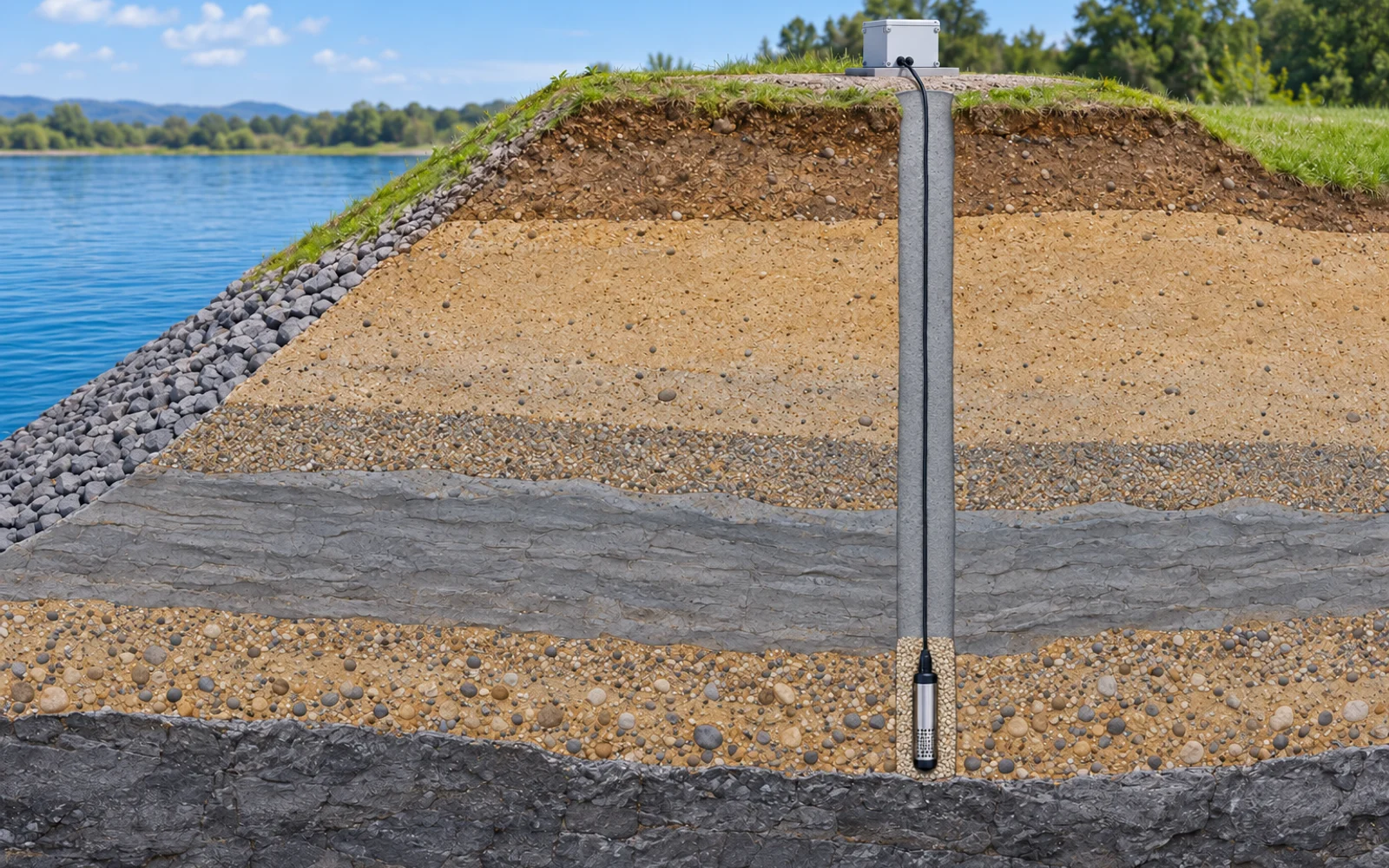
A piezometer measures water pressure at its hydraulic connection to the surrounding material. Its response represents that installation and its formation context, not the entire slope.
The GEOKON 4500 manual describes vibrating-wire piezometers, instrument-specific calibration and data reduction. The manufacturer’s coefficients and reference procedure belong to the individual instrument. A convenient equation from another gauge should not be copied into the logger.
Preserve the borehole log, tip elevation, filter or response zone, sealing details, cable route and commissioning readings. Those records may explain a trend more effectively than additional decimal places.
How is pressure converted to head?
For a hydrostatic water column, pressure head is h = p / (ρg). Use pressure relative to the appropriate reference, fluid density ρ and gravitational acceleration g. The units must be consistent.
For an illustrative water density of 1,000 kg/m³ and g of 9.81 m/s², 98.1 kPa corresponds to 10 m of pressure head. If the sensor elevation is 120 m in the project datum, the corresponding piezometric elevation is 130 m under those assumptions.
This example does not establish a site water level or an alarm value. Density, pressure reference and hydraulic conditions can change the interpretation.
| Data layer | Example field | Required context |
|---|---|---|
| Original observation | Frequency or device reading | Instrument ID and timestamp |
| Pressure | kPa | Calibration, zero and correction history |
| Pressure head | Metres of fluid | Density and gravity assumptions |
| Piezometric elevation | Project-datum elevation | Surveyed tip elevation and datum |
| Interpreted trend | Rise, fall or anomalous response | Geology, rainfall, loading and other instruments |
Why is barometric correction not automatic?
An unvented instrument can respond to atmospheric-pressure changes, but the appropriate correction depends on the instrument and installation. A vented instrument has different reference behavior.
The GEOKON manual cautions that applying an unnecessary correction can introduce error where atmospheric effects at the piezometer are attenuated. Keep the barometric series and investigate the observed response before applying a blanket adjustment.
Temperature correction also uses the instrument’s calibration information. Record the sign convention and calculation version so a future reviewer can reproduce the series.
Establish a baseline that can be reconstructed
Keep factory calibration, site zero, installation observations and commissioning time distinct. Record when hydraulic equilibrium and normal operating conditions were considered adequate for the chosen baseline.
A change in logger channel, cable repair or processing coefficient can resemble a pressure change. Link maintenance events to the data timeline. Preserve raw observations so revised calibration can produce a traceable new result rather than overwriting the evidence.
What should trigger a data-quality investigation?
Investigate abrupt steps, frozen values, implausible oscillation, unexplained disagreement with nearby installations and changes coinciding with maintenance. Do not automatically remove an unusual value; the observation may reflect a real hydraulic change.
Use independent readings or the instrument’s approved verification procedure where available. Report missing data as missing. A flat line created by carrying forward the last reading can conceal the period when information was unavailable.
The tailings instrumentation guide places pore pressure alongside deformation and other observations. Interpretation and response thresholds belong to the site’s responsible geotechnical team.
Deliver the calculation as well as the chart
Supply the instrument register, installation record, calibration files, datum, raw and processed series, environmental records, exclusions and calculation version. Identify which trends are measured and which are inferred.
Retain the conversion method, sensor datum and installation record with the time series. Pressure, hydraulic head and elevation then remain distinguishable when readings move between instruments, software and reports.
FAQs
Is a piezometer a displacement sensor?
No. A piezometer measures water pressure at its installation. It can inform a geotechnical interpretation but does not directly measure slope or structural displacement.
Should barometric pressure always be subtracted?
No. Treatment depends on whether the transducer is vented, its pressure reference, installation and observed response. Follow the instrument method and site interpretation.
What is needed to report a piezometric elevation?
Use a valid pressure-head calculation plus the surveyed sensor elevation in a stated datum. Record density assumptions and relevant corrections.