Traffic occupancy measures how much of an observation period a detection zone is occupied. Density counts vehicles along a length of road. The two can be related under specific assumptions, but they answer different questions and cannot be substituted simply because both increase during some congested conditions.
Table of Contents
What does each metric count?
Occupancy, density and flow describe different aspects of traffic. Their units reveal why an API field cannot be renamed without changing its meaning.
FHWA’s traffic-stream discussion distinguishes time occupancy from density and explains that detector-zone geometry affects occupancy. Its theoretical relationships require attention to measurement and traffic assumptions.
| Metric | Definition for this article | Typical unit | Observation basis |
|---|---|---|---|
| Occupancy | Fraction of valid time a zone is occupied | Percent | A detection zone over an interval |
| Density | Vehicles present along a road length | Vehicles/km/lane | A spatial section at a defined time |
| Flow | Vehicles crossing a reference line per time | Vehicles/hour/lane | Crossing events over an interval |
| Speed | Distance traveled per time | km/h | Individual or specified aggregate observations |
Suppose a zone is occupied for 18 seconds during a complete 60-second interval. Occupancy is 30%. Separately, 12 vehicles observed along a 0.4 km single-lane section correspond to 30 vehicles/km/lane. The identical number 30 is coincidental: the quantities and units differ.
Why does detector geometry matter?
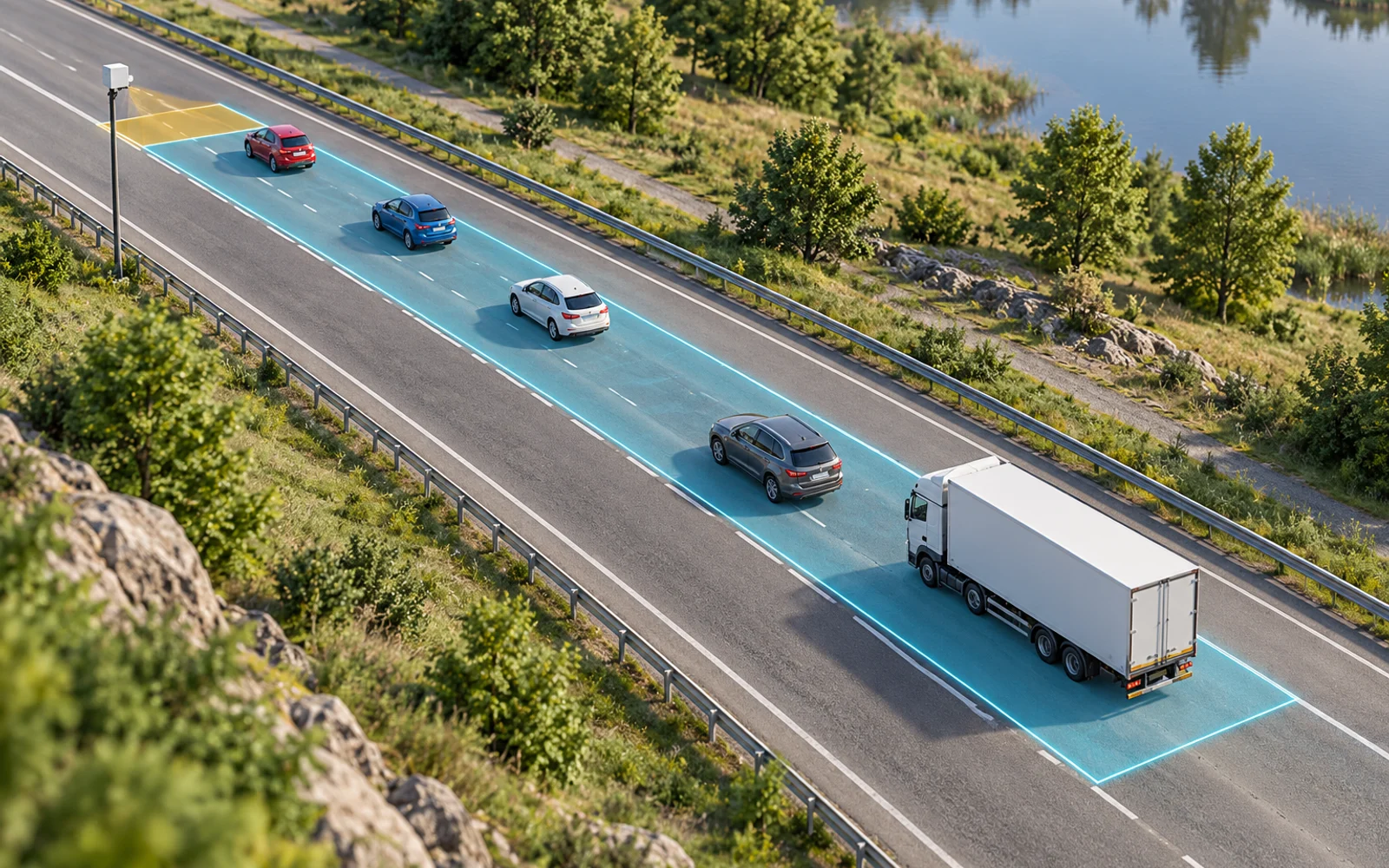
A longer detection zone remains occupied longer as a vehicle passes. Trucks also occupy a zone differently from shorter vehicles. A comparison between two sites must account for those differences.
If a tracking system reports the percentage of a polygon covered by vehicle boxes, that is not automatically conventional time occupancy. Request the precise definition, aggregation rule and treatment of overlapping detections.
A sensor that cannot reliably report stationary presence may produce a misleading picture of stopped traffic. Check the waveform, processing and supported output of the exact model rather than assuming all radar products measure occupancy in the same way.
When can flow and speed estimate density?
The relationship q = k × u connects flow q, density k and space-mean speed u under a compatible traffic representation. Units and observation periods must agree.
As an illustrative steady-flow case, 900 vehicles/hour/lane divided by 45 km/h gives 20 vehicles/km/lane. An arithmetic average of spot speeds is not necessarily the required space-mean speed. Mixing measurement types can bias the result.
The calculation becomes especially fragile when conditions vary rapidly, vehicles stop or the spatial and temporal windows do not match. Dividing a noisy flow estimate by a speed approaching zero is not a robust queue-length method.
How should a congestion indicator be accepted?
Specify the operational question first: queue presence, queue extent, speed reduction or capacity analysis. Then choose measurements that directly support it.
Compare the proposed indicator against independently observed conditions across free flow, slow traffic, standing queues and recovery. Evaluate each lane and vehicle mix. Check how a communications gap appears: unavailable occupancy must not be rendered as an empty road.
The queue detection guide addresses the separate task of locating a queue boundary. The zone-design article covers where the measurement occurs. A well-placed zone still needs a clearly defined output.
Keep definitions with the data
A handover should include lane identity, zone geometry, interval length, valid observation time, output units, speed averaging method and quality flags. Version that contract when firmware or configuration changes.
Keep sample records and calculation definitions with the indicator. Downstream analysts need the same interval, zone length, vehicle treatment and missing-data rules to reproduce it.
FAQs
Is occupancy the percentage of road space filled with vehicles?
For a presence detector, occupancy usually means the percentage of time its zone is occupied. Spatial road coverage is a different measurement and must be named explicitly.
Can occupancy be converted directly into density?
Only through a model with appropriate assumptions about detection-zone length, vehicle lengths, speeds and traffic conditions. The conversion needs validation.
Does zero flow mean the road is empty?
No. Vehicles may be stopped over the detector. Combine flow with valid presence, occupancy or other observations before interpreting conditions.