Vehicle headway is meaningful only after the crossing event is defined. Front-to-front time at one reference line differs from the clear gap between the rear of one vehicle and the front of the next. Sensors, analysts and downstream applications must use the same definition before their numbers can be compared.
Table of Contents
How are headway and gap calculated?
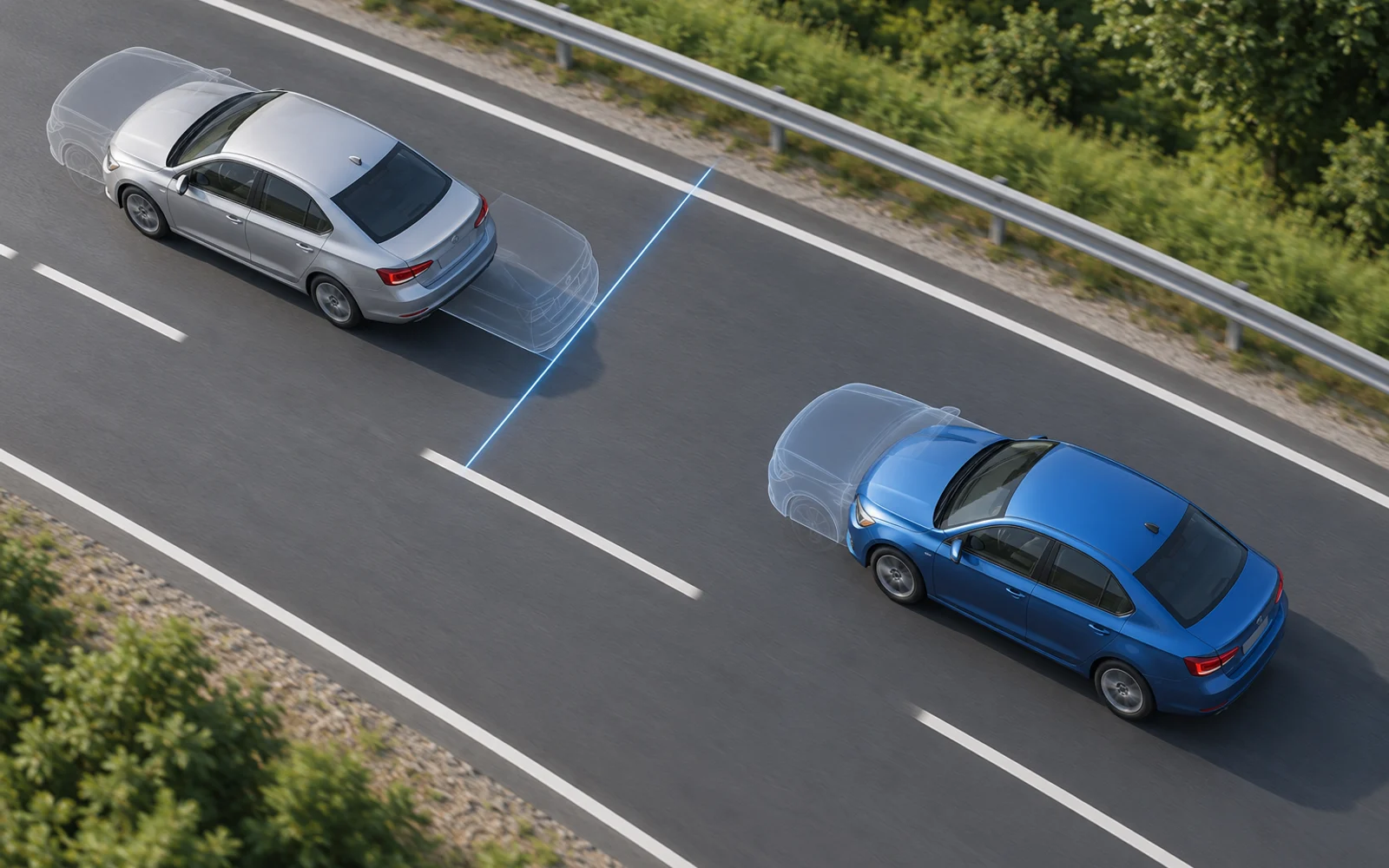
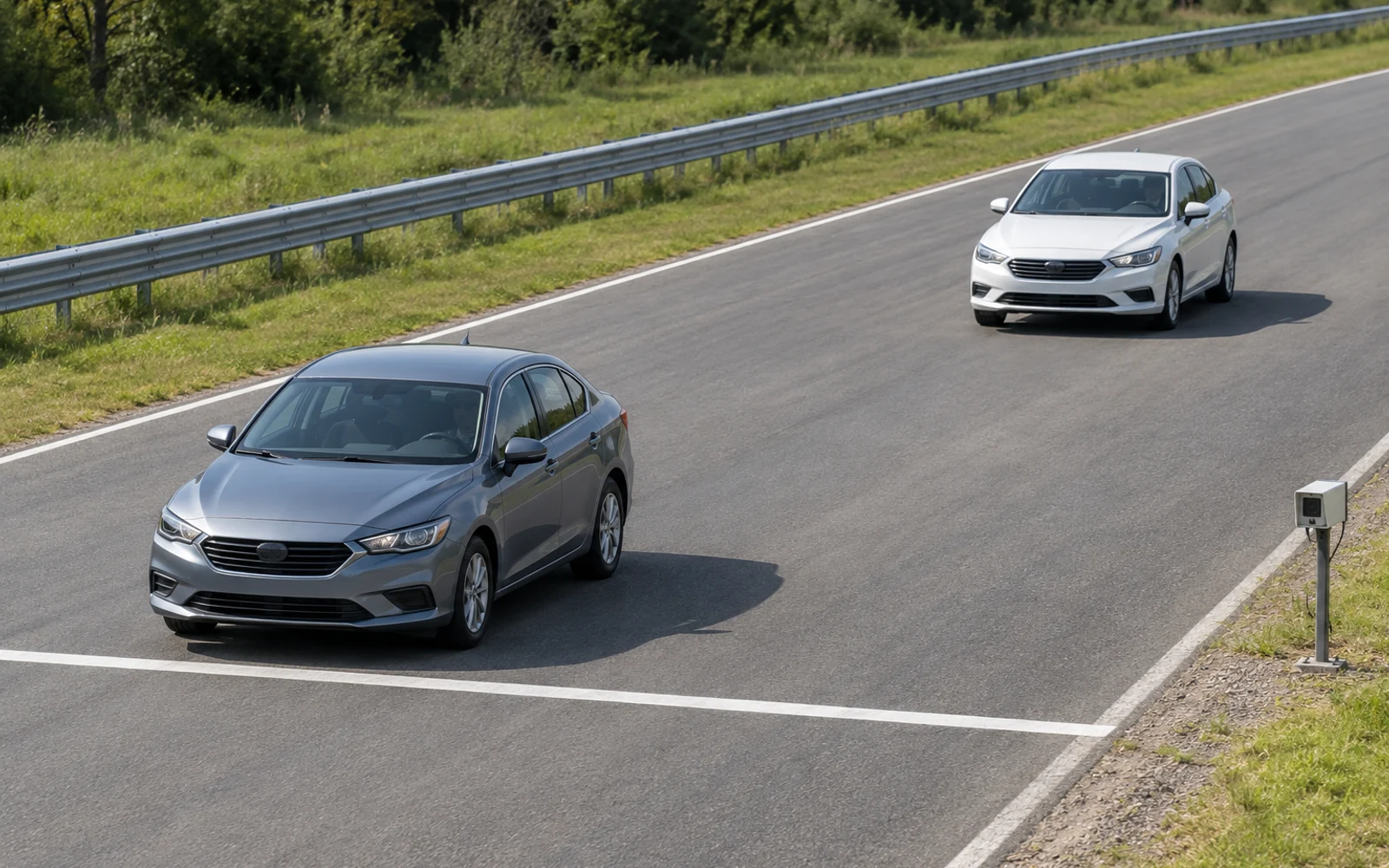
At one reference line, front-to-front time headway is the following vehicle’s front-crossing time minus the leading vehicle’s front-crossing time. Clear time gap uses the leading vehicle’s rear-crossing time instead.
FHWA’s traffic-stream chapter discusses headway and the relationship between observation methods and traffic variables. It is useful background for specifying which events a sensor must provide.
Consider these hypothetical observations from one lane:
| Event | Time relative to the observation start |
|---|---|
| Vehicle A front crosses | 10.0 s |
| Vehicle A rear crosses | 10.4 s |
| Vehicle B front crosses | 12.5 s |
Front-to-front headway is 2.5 seconds. Clear time gap is 2.1 seconds. Those are different outputs from the same pass. A detection-zone entry or exit time may differ from a crossing of an ideal line, especially if the zone has appreciable length.
Which reference point does the sensor track?
A tracker may report a bounding-box center, a radar reflection point or an estimated vehicle front. Those points are not interchangeable. Obtain the manufacturer’s event definition and document how the crossing is generated.
For video, check perspective and the way the vehicle box is projected onto the road. For radar, determine whether the tracked point corresponds to the same vehicle feature over its trajectory. A moving reflection point can affect an event timestamp.
Specify lane identity at the crossing. Define what happens when a vehicle changes lane, is occluded, reverses or produces a fragmented track. Exclude or classify ambiguous pairs according to a documented rule; do not silently assign them to the nearest lane.
How does timestamp uncertainty affect the interval?
The uncertainty of a difference depends on both event timestamps and their relationship. A clock shared by both events may cancel a constant offset, while different sensors can introduce relative offset and drift.
Video frame rate limits temporal granularity. At 25 frames per second, frames are spaced by 0.04 seconds. That spacing is not a complete uncertainty estimate because crossing interpolation, exposure, detection and timestamp assignment also matter.
A sensor can be internally consistent yet disagree with a reference video if one timestamp represents capture and the other represents receipt. Align the event definitions and clock basis before adjusting the detector.
Validate pairs as well as averages
Build a reference set that preserves each vehicle pair, lane, crossing time and confidence. Compare matched events and report missed or extra vehicles. One missed vehicle can merge two intervals and produce an apparently long headway.
Review distributions across traffic regimes, vehicle lengths and lighting or weather conditions relevant to the site. An average can look correct even if the system alternates between short false pairs and long merged pairs.
Keep the sample selection and exclusion rules. If a demonstration contains only isolated cars, it does not demonstrate performance in dense or occluded traffic.
What should the export explain?
Include the reference-line geometry, event type, lane, vehicle IDs, timestamps, headway or gap units, quality state and configuration version. A consumer should not need to guess whether a field refers to time or distance.
The zone-design guide helps define the road event, while the occupancy and density article explains related metrics. None of these measurements alone establishes a universally safe following interval.
Retain matched event pairs with the agreed detection line and vehicle-reference convention. This keeps later headway comparisons tied to the same physical event.
FAQs
What is the difference between time headway and time gap?
At a fixed line, front-to-front headway compares successive vehicle fronts. Clear time gap compares the leading vehicle's rear with the following vehicle's front.
Can vehicles in different lanes form a headway pair?
Not for a lane-specific following measurement. Lane identity and rules for lane changes must be explicit; cross-lane arrival intervals are a different quantity.
Does measured headway establish a safe following distance?
No. It is an observation. Safety interpretation depends on the application and conditions and requires a separate justified method.