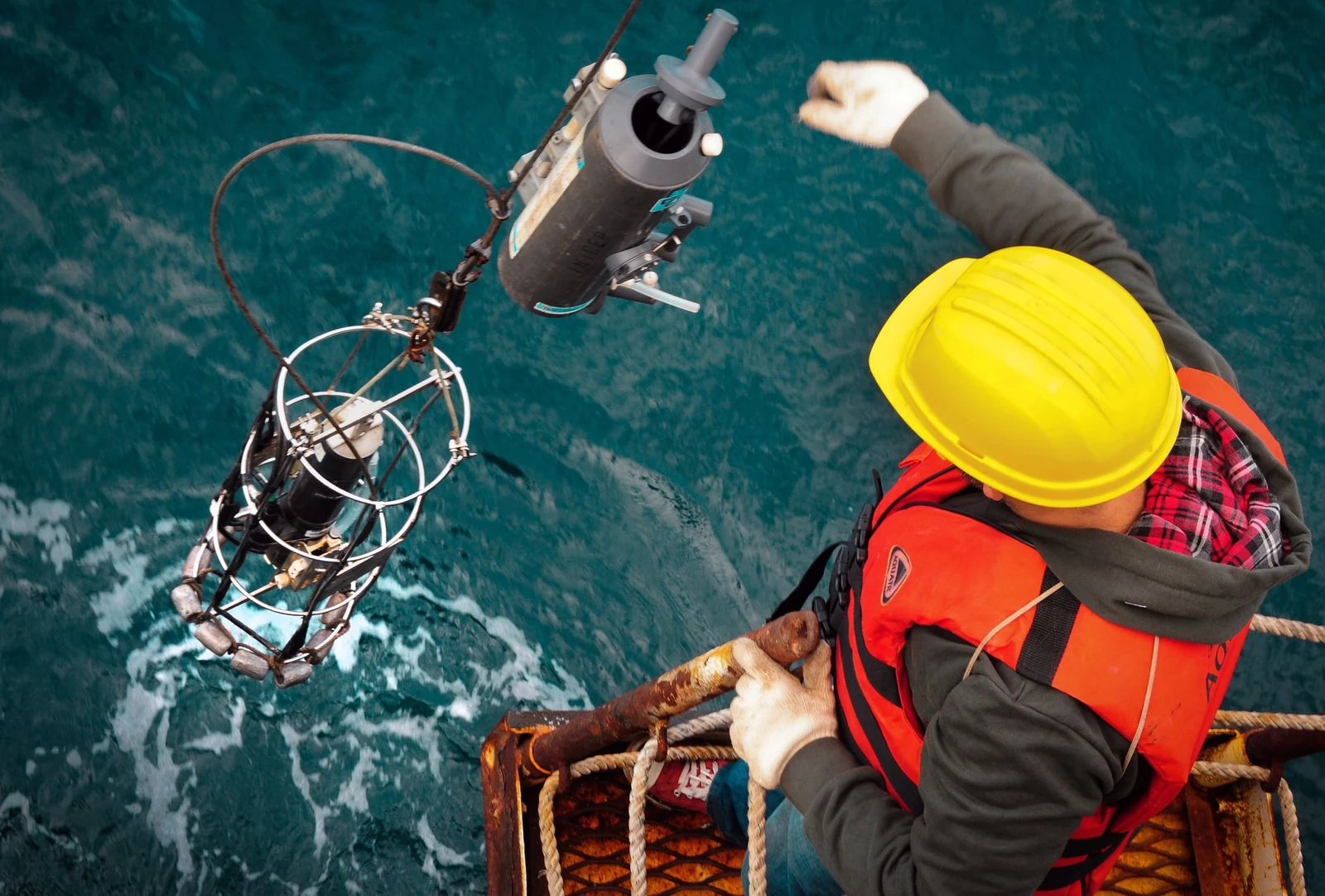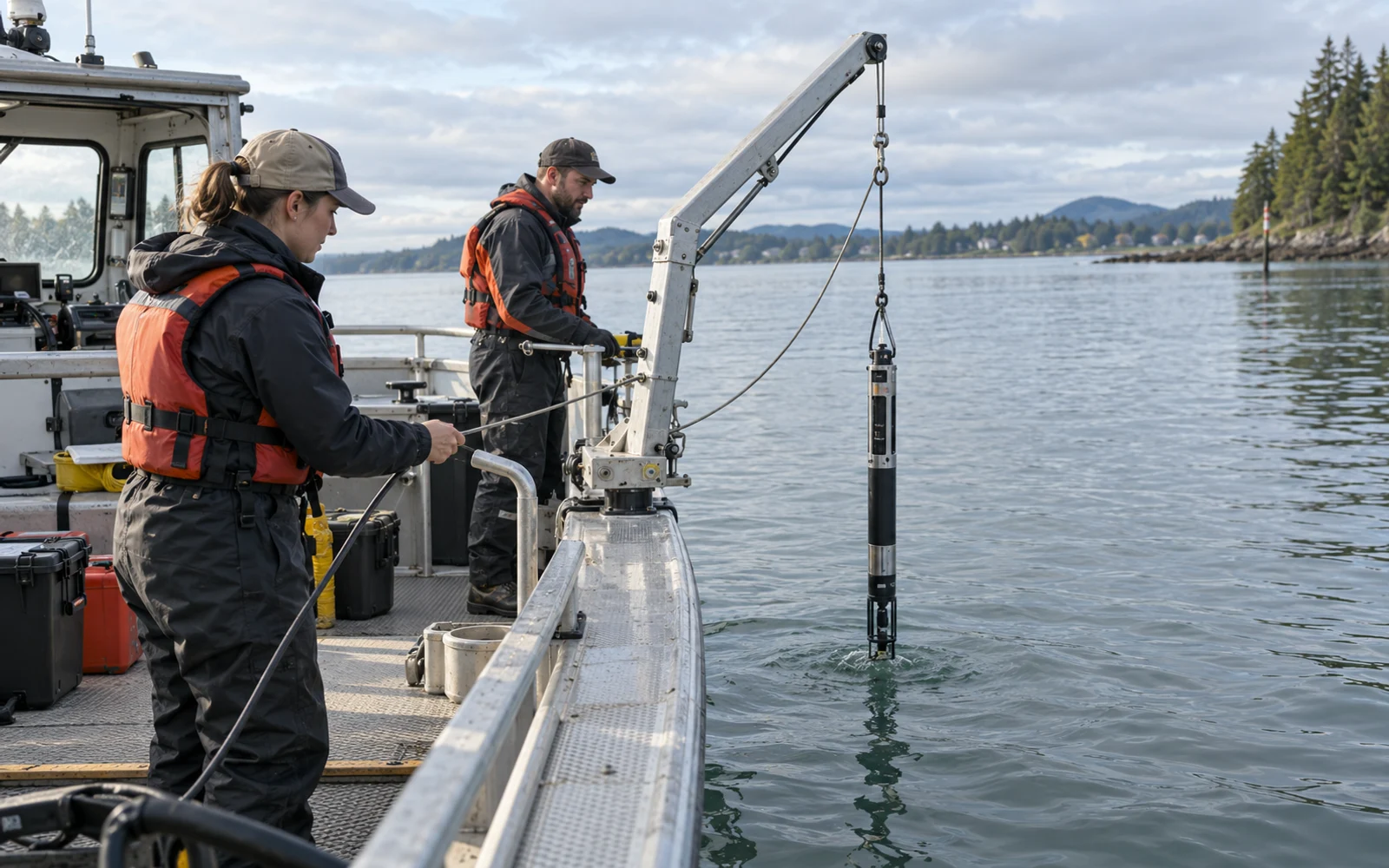
A sound velocity profile is a depth-dependent record of how fast sound travels through the water column. For multibeam surveying, its value depends on whether it represents the water traversed by the beams. Plan casts and profile assignments around changing conditions, not only a fixed timetable.
Table of Contents
Why is a surface reading not a water-column profile?
A surface sensor measures sound speed near its location; a profile describes changes with depth. Multibeam beam steering and propagation through the water column need appropriate inputs for their different roles. One plausible surface number cannot establish that deeper water is represented.
NOAA’s 2022 hydrographic specifications discussion of sound-speed correction explains both travel-time conversion and refraction along oblique beam paths. Use the edition specified by the project contract when setting survey acceptance requirements.
Temperature, salinity and pressure influence the water-column conditions. A profile from another place or time may therefore be a poor match even when its file is valid. A survey system accepting the file proves ingestion, not representativeness.
The broader multibeam acceptance guide covers position, attitude, timing and coverage. This article isolates the cast-planning and profile-assignment decisions that need their own field record.
Choose cast triggers around changing water
Begin with the client’s required method and the anticipated water variability. Identify changes such as a river plume, tide transition, movement between sheltered and open water, or an extended interruption. Treat these as reasons to review the sampling plan, not as automatic proof that every cast is inadequate.
Before acquisition, define who can request a new cast, how the vessel will deploy safely, and how the result reaches the acquisition and processing systems. An instrument that remains packed away because deployment was not planned does not improve the survey.
The Multibeam Advisory Committee’s SVP mission-planning research explores how spatial oceanographic variability affects sounding uncertainty. Its page explicitly describes a preliminary research tool. Such planning information can help target attention; it does not replace measured conditions or acceptance checks.
A practical rule is to make every decision to continue with an existing profile explainable. Record the comparison observations and the affected area. “The software chose it” is not a sufficient field rationale.
A cast-to-line traceability register
Use a register that connects water observations to the data they influence. The proposed fields below are a project-management aid, not a prescribed survey standard.
| Record | Minimum useful content | Question it answers |
|---|---|---|
| Cast identity | Instrument, file, position, time and time zone | Which water observation was used? |
| Depth extent | Start/end depth, gaps and rejected portions | Was the relevant water column sampled? |
| Conditions | Tide context, weather, area and visible water changes | Why was this cast considered representative? |
| Assignment | Survey line/time range and selection method | Which soundings depend on this profile? |
| Verification | Surface comparison and suitable overlap checks | What evidence supports continued use? |
| Revision | Previous assignment, replacement and reason | Can another processor reproduce the correction? |
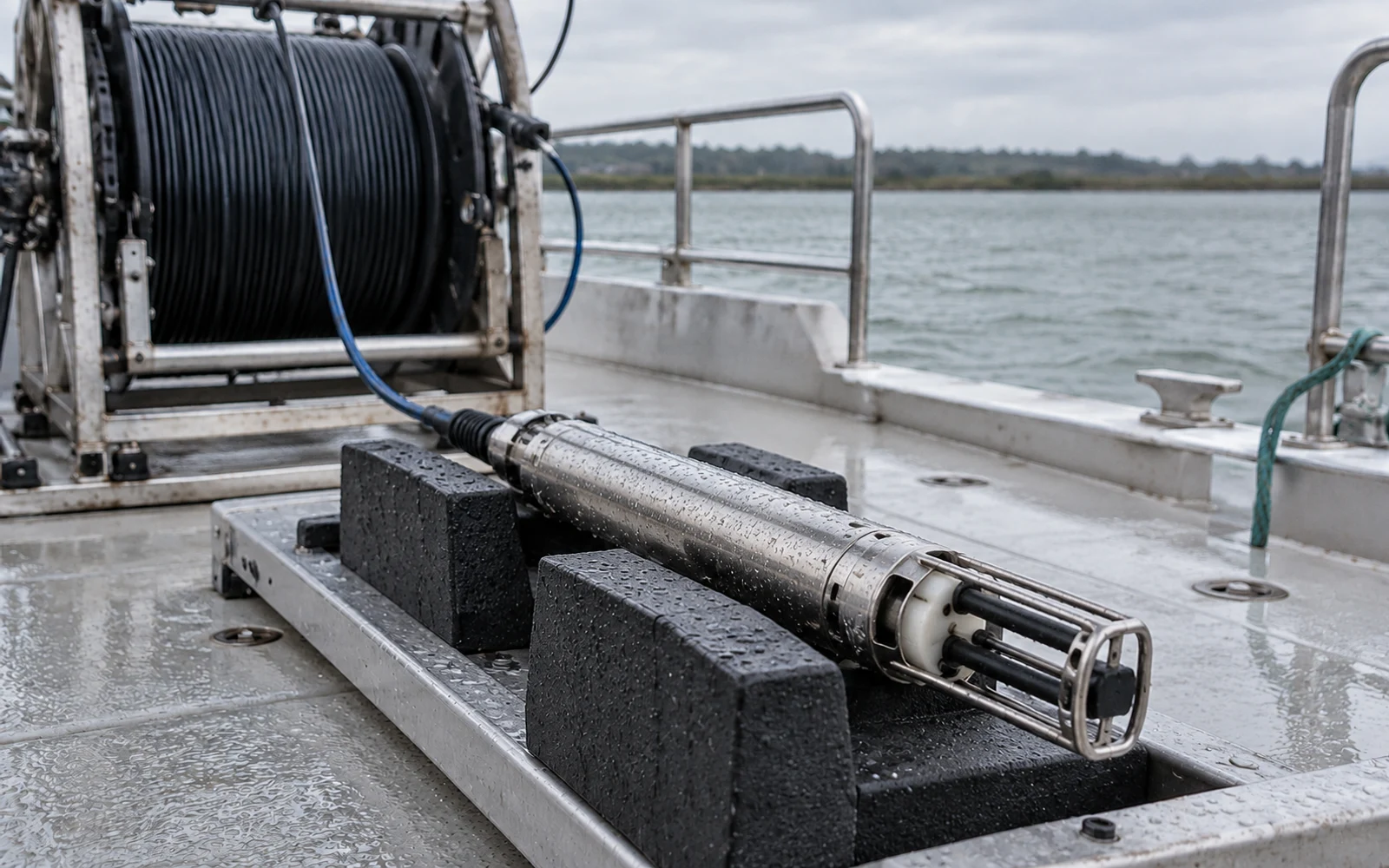
Keep the original cast even if a corrected or cleaned version is produced. Record the processing change separately. If a profile does not reach the required depth, document the treatment of the unmeasured interval and whether the specification permits it; do not silently imply that extrapolated water was observed.
What can a curved swath actually tell you?
An unexpected curved shape or disagreement in overlap is a diagnostic prompt, not a unique signature. Review sound-speed inputs alongside sensor alignment, motion, timing, navigation and processing configuration. Changing a profile until the picture looks flat risks compensating for the wrong cause.
Compare suitable overlapping or crossing observations after controlling for seabed geometry and genuine change. Identify which lines were acquired under comparable conditions. A discrepancy over a steep feature needs different interpretation from one over a stable, relatively uniform reference area.
If a new profile leads to reprocessing, retain both assignments and quantify the resulting differences over the affected data. Check whether the intended quality criteria are met; do not use visual smoothness alone as acceptance.
Close the loop before delivering the surface
The delivery should make the sound-speed decision reproducible: original casts, accepted profiles, assignment rules, sensor configuration, quality observations and the scope of reprocessing. State any unverified area instead of letting it inherit the confidence of adjacent lines.
Agree on the sound-speed records and quality checks alongside the requested bathymetry. Each profile should remain linked to its location, time and the lines processed with it.
The useful outcome is not a large number of casts. It is a supported relationship between each survey interval, the water-column evidence used for it and the checks that justify the delivered surface.
FAQs
Can a surface sound-speed sensor replace a profile?
No. A surface measurement describes local conditions near the sensor. It does not describe deeper layers through which oblique beams travel, so the profile and surface inputs have different roles.
How often should a new sound-speed cast be taken?
Follow the applicable survey specification and adapt sampling to water variability, movement between water masses and quality checks. There is no single interval that establishes adequacy for every survey.
Does a curved multibeam swath always mean a bad profile?
No. Refraction is one possible cause, but installation, motion, timing and processing problems can also affect the surface. Investigate the inputs rather than treating the visual pattern as a diagnosis.