An inclinometer baseline is the accepted reference survey against which later casing profiles are compared. If its depth positions, orientation or repeatability are uncertain, subsequent plots can confuse survey error with ground movement. Establish the reference record before using displacement trends to support site decisions.
Table of Contents
What is an inclinometer baseline?
It is an accepted reference profile, not simply the first file in a folder. Later observations describe change relative to that profile and its reference assumptions. They do not automatically recover movement that occurred before the baseline or rigid translation of the entire casing.
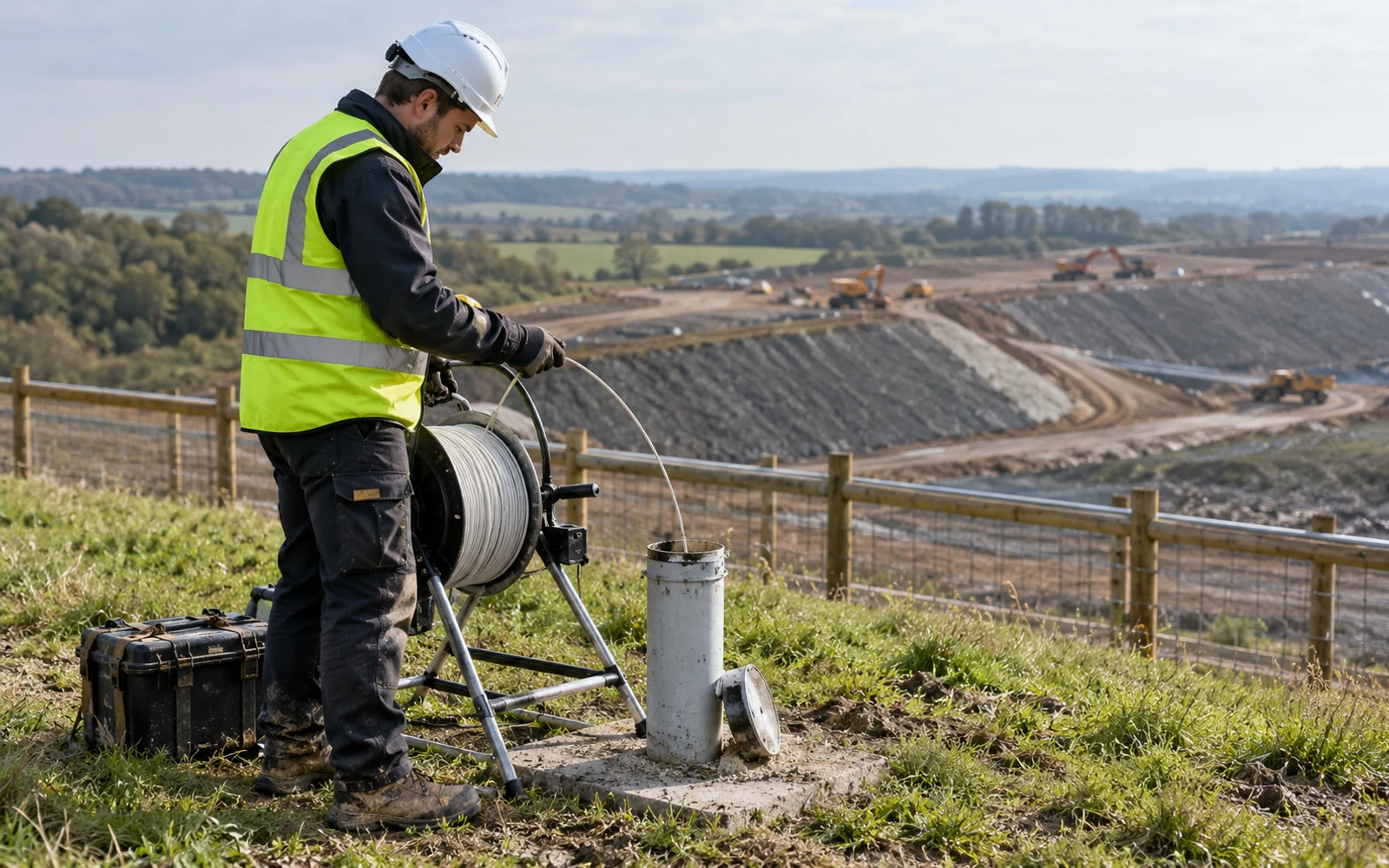
For a portable probe system, measurements of casing inclination at successive depths are used to derive a profile. The GEOKON Model 6000 manual describes this method and comparison with an original survey. Its procedure is instrument-specific; do not copy its reading intervals or numerical tolerances into an unrelated system.
The project record should state casing identity, groove orientation, depth reference, probe and cable identity, processing method and the reference from which displacement is accumulated. If the assumed fixed portion may move, that limitation belongs in the interpretation.
Establish repeatability before construction changes
Capture the condition of the installation and the state of works when the reference is acquired. Was grouting complete under the installation method? Had excavation started? Was the casing head altered? These details determine what “since baseline” actually means.
Use repeat runs appropriate to the project method to assess measurement consistency. Compare depth-by-depth observations and derived profiles, not only the top displacement. Keep raw readings and the rationale for accepting a particular run or a defined baseline combination.
A proposed baseline review can use the following matrix. Acceptance values must come from the installed system, survey procedure and project requirements.
| Check | Evidence to retain | If the check fails |
|---|---|---|
| Installation identity | Casing record, location and orientation | Resolve identification before combining surveys |
| Depth repeatability | Cable marks, suspension/reference point and reading sequence | Repeat affected measurements or qualify the run |
| Probe condition | Inspection, calibration and equipment IDs | Investigate damage or equipment change |
| Repeat survey consistency | Raw paired runs and comparison plots | Resolve the discrepancy before adopting a baseline |
| Reference assumption | Basis for the fixed end or independent position evidence | Report relative movement with its limitation |
| Construction context | Date, work stage and disturbances | State what the baseline cannot represent |
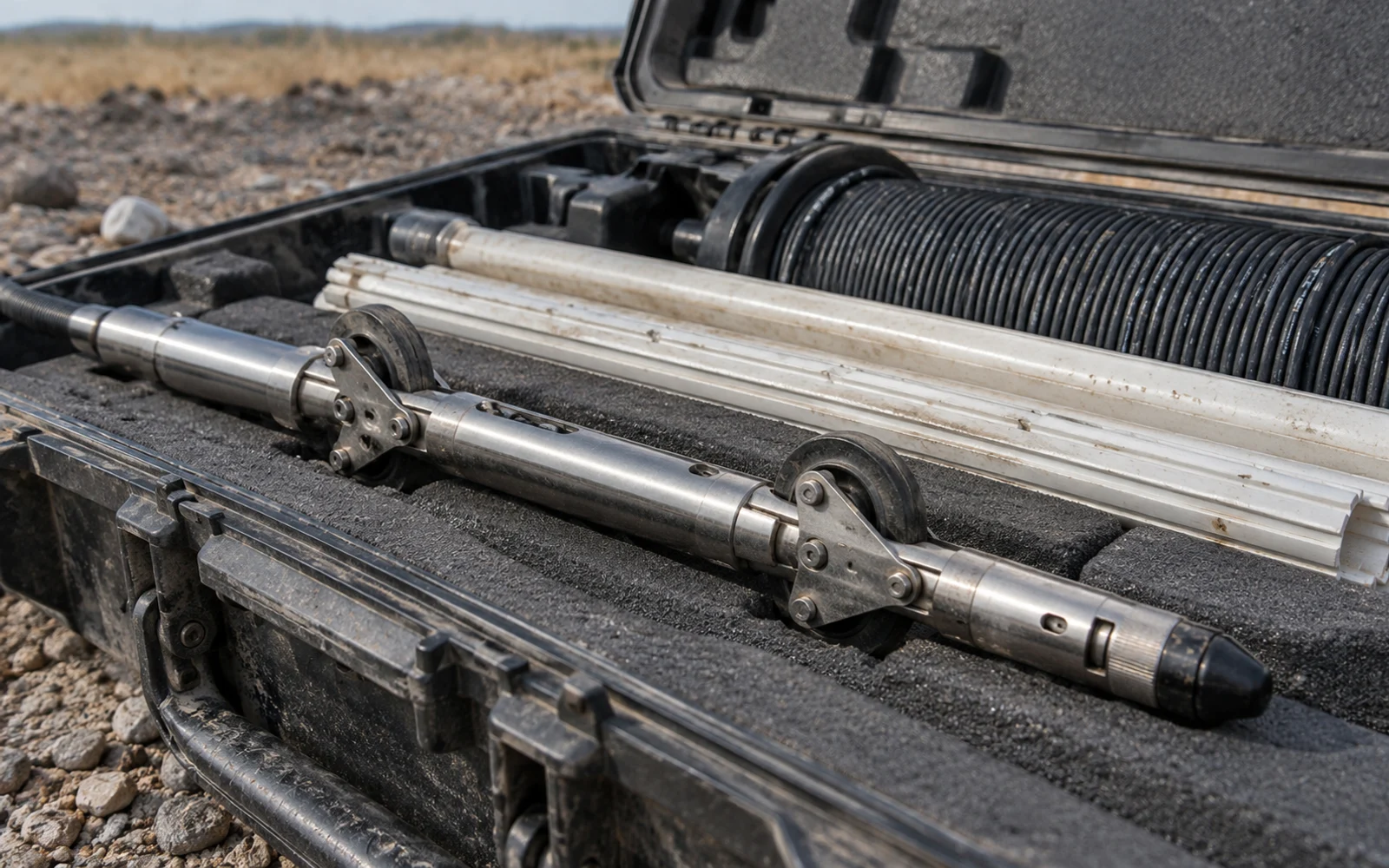
Unlike the broad slope-instrument selection guide, this review is about the reliability of one installed measurement series. Adding another sensor does not repair an undocumented baseline.
How do checksums help identify a suspect run?
For supported reversal methods, adding corresponding opposite-orientation readings provides a diagnostic of the probe’s offset and measurement consistency. An unusual checksum pattern can prompt investigation of a reading or survey run. It is not a direct measure of ground displacement.
The GEOKON inclinometer probe manual identifies problems such as skipped depths, inadequate settling, positioning differences and equipment faults. Apply the actual manufacturer’s definitions and limits. A checksum value without units, conversion and instrument context cannot be assessed meaningfully.
Review anomalies while reacquisition remains possible. Flag the original record, investigate the cause and store any repeat as a separate observation. Do not silently edit a suspect value to make the curve smooth. If correction is justified by a documented method, preserve both the original and revised series.
Read local and cumulative displacement together
A local change between measurement levels and a cumulative displacement profile answer different questions. Local differences help identify where the profile changes; accumulation shows the combined effect relative to the chosen reference. A small systematic measurement bias can become more conspicuous after accumulation.
For a sensitivity example, a repeated 0.2 mm bias across 20 intervals adds to 4 mm. It shows why the shape of the raw and reduced data deserves review before interpreting a top-of-hole value.
Compare results with installation history, independent survey observations and relevant site information. A piezometer trend measures a different quantity and may provide context, but it does not validate the inclinometer automatically. Unexpected behavior should enter the project’s established review and response process rather than wait for a visually convincing plot.
Preserve the reference through equipment changes
Replacing a probe, cable, processing package or casing-head reference can introduce a discontinuity. Record the change, arrange an overlap comparison when feasible and distinguish a new baseline from a continuation of the old series. Never reset the reference merely to remove an inconvenient trend.
The monitoring owner should be able to recover the accepted baseline, raw runs, quality flags, equipment history and interpretation notes for any reported profile.
The deliverable is a traceable displacement history with a stated reference—not an unexplained curve whose zero changes when personnel or equipment change.
For automated records, distinguish the measurement, aggregation and upload intervals so a change in reporting frequency does not obscure how movement was observed.
FAQs
Does the first inclinometer survey have to be the baseline?
Not automatically. The baseline should be an accepted, repeatable reference with documented installation and measurement conditions. Retain earlier runs and explain which survey or defined combination was adopted.
Does a good inclinometer checksum prove the ground is stable?
No. A checksum is a measurement-quality diagnostic. It does not prove reference stability, correct interpretation or absence of ground movement, and must be reviewed with other checks.
Can an inclinometer measure movement before its baseline?
A later comparison cannot reconstruct displacement that occurred before the accepted reference without other evidence. State the baseline date and avoid presenting change since baseline as lifetime movement.