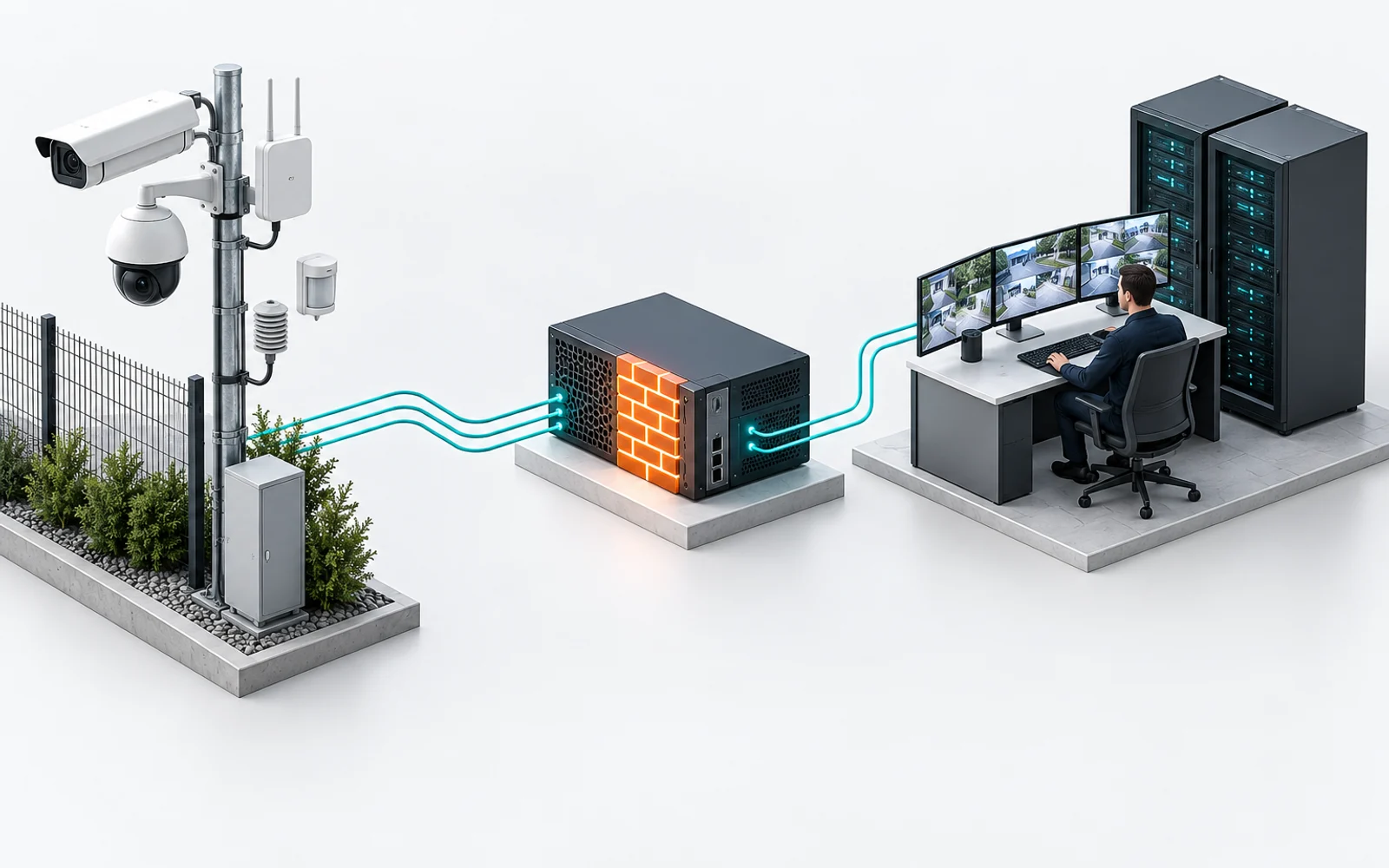
Security sensors often need to send observations to a platform while receiving time, configuration and maintenance services. OT network segmentation starts by defining those necessary flows and enforcing boundaries around them. The result should support operations without giving every connected device unrestricted access to the rest of the site.
Table of Contents
Which systems belong inside the boundary?
Group devices by operational role, required trust and consequence of compromise or failure. Outdoor cameras, radar interfaces, recording servers and operator workstations do not necessarily need the same access.
NIST SP 800-82 Revision 3 addresses OT security together with performance, reliability and safety constraints. Use it as a design reference for the architecture; citing the publication does not certify that a deployment conforms to every applicable requirement.
Start with an asset and dependency inventory. Identify who owns each device, how it is configured, which services it needs and which functions continue if a connection is lost. Unknown dependencies are a common reason a hurried firewall change disrupts operations.
Write an allowed-flow matrix
For every necessary communication, define initiator, destination, service, purpose, authentication and owner. Confirm the actual product behavior: some integrations initiate sessions in a different direction than their diagram suggests.
| Source role | Destination role | Purpose | Restriction to specify |
|---|---|---|---|
| Camera or sensor | Approved recorder or collector | Video or event delivery | Named endpoints and supported protocol |
| Device | Approved time service | Clock synchronization | Defined servers and monitored reachability |
| Platform | Identity or certificate service | Authentication and trust | Required operations only |
| Maintenance entry point | Device-management interface | Authorized configuration | Named access and controlled window |
| Platform | Export destination | Approved evidence transfer | Explicit destination and logged action |
| Device-health collector | Monitored equipment | Operational status | Supported read access and polling scope |
This is a planning matrix, not a ready-to-deploy firewall rule set. Ports, direction and security capabilities must be resolved from the installed products and accepted network design.
Why is a VLAN label not enough?
A VLAN separates broadcast domains, but routing can reconnect them. The boundary requires enforced access rules and an understanding of alternate paths.
Review dual-homed servers, remote-support appliances, wireless links and shared management interfaces. A recording server connected to two networks should not be assumed to provide secure isolation merely because it has two interfaces. Verify its routing, host controls and supported deployment pattern.

How should remote maintenance be handled?
Provide an approved entry point with named identities and permissions appropriate to the work. Use strong authentication and encrypted access supported by the environment. Record changes and revoke temporary access when the task ends.
Plan support before an outage. If the only recovery procedure requires opening broad access during an incident, the design has an unresolved operational dependency. Test credential recovery, certificate renewal and offline support paths under the site’s change process.
Do not run intrusive discovery or active tests against operational devices without a method suited to their reliability constraints. Passive inventory and a representative test environment can resolve many dependencies first.
Test the permitted functions across the boundary
Verify recording, event delivery, time synchronization, health reporting and required updates. Then verify that connections outside the agreed matrix are rejected using an approved test plan.
Test failure behavior as well: blocked time traffic, unreachable identity service or an expired certificate can affect operations without making the entire network appear offline. The platform should show the specific degraded function.
The security integration checklist connects these communications to the event model. Platform failover testing addresses recovery when a required service disappears.
Keep the architecture maintainable
Deliver the asset register, zone diagram, allowed-flow matrix, rule ownership, verification record and rollback procedure. Link each exception to a reason and review date.
Preserve the approved flow matrix, network diagram and recovery cases with the system configuration. When a sensor or service changes, these records show which dependencies need to be tested again.
For software lifecycle support, release-specific SBOM procurement connects the installed inventory to vulnerability notices, supplier responses and verified updates.
FAQs
Is placing devices on different VLANs sufficient segmentation?
Not by itself. Routing and access rules must enforce the intended boundary, and shared services or management paths can still connect the zones.
Should every sensor have direct access to corporate systems?
Access should follow a documented operational need. Use defined integration points and restrict source, destination and service according to the approved architecture.
How can maintenance access remain available without permanent broad access?
Use an approved controlled entry point, named accounts, limited permissions, time-bounded access where supported and recorded changes, with a tested support procedure.