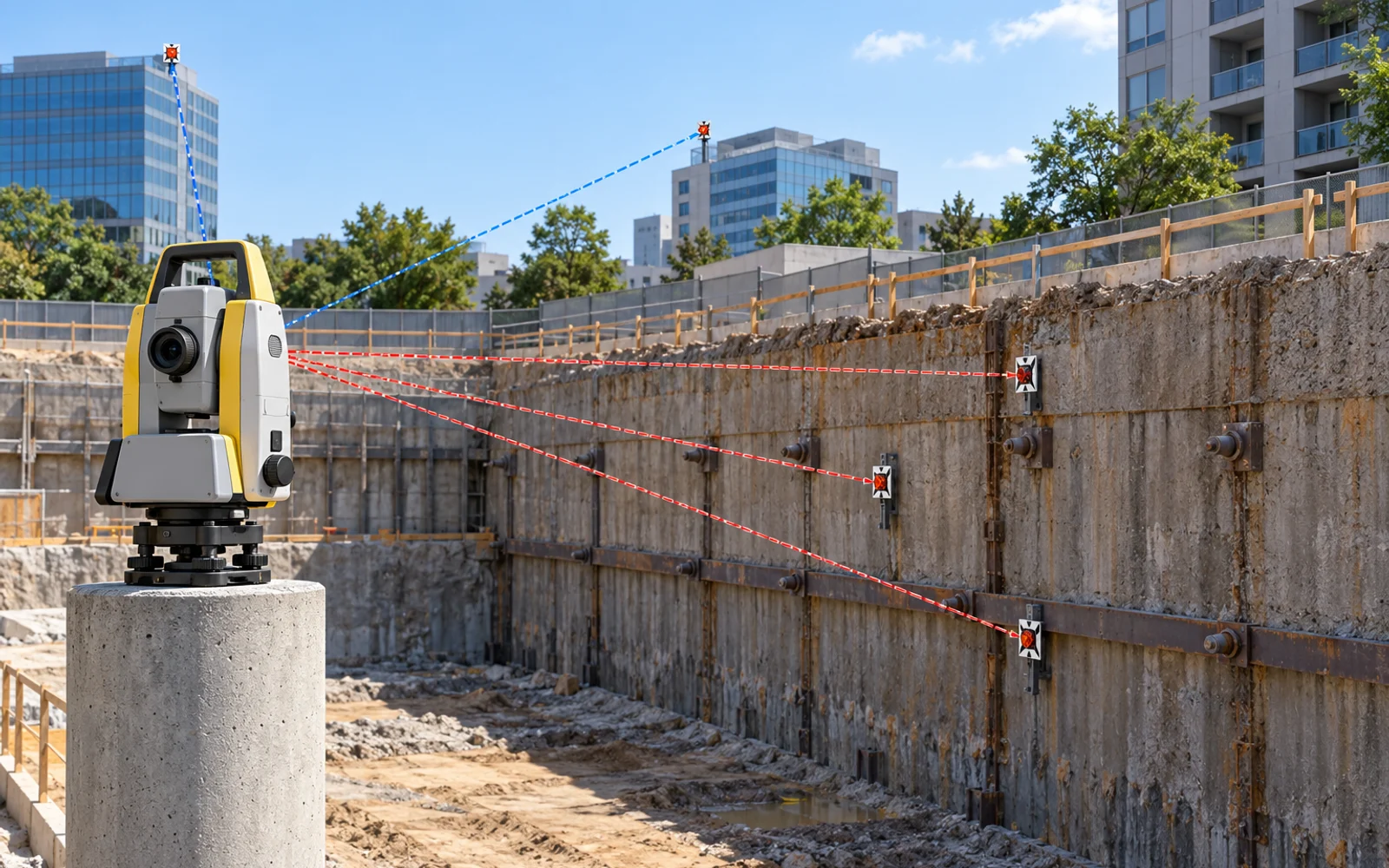
Robotic total station monitoring turns repeated angle and distance observations into coordinate changes at selected prisms. The result is only as useful as the reference network behind it. A moving instrument, unstable reference or changed prism identity can imitate the deformation the system is intended to measure.
Table of Contents
Which points define stability?
Reference points establish the coordinate basis against which monitored points are compared. Their stability must come from the site model and independent evidence, not merely from being placed outside the construction fence.
Leica’s Heidelberg monitoring case describes separate reference and monitoring prisms together with geotechnical measurements. It illustrates a network architecture; the reported outcome of that project should not be treated as a guarantee for another wall or instrument.
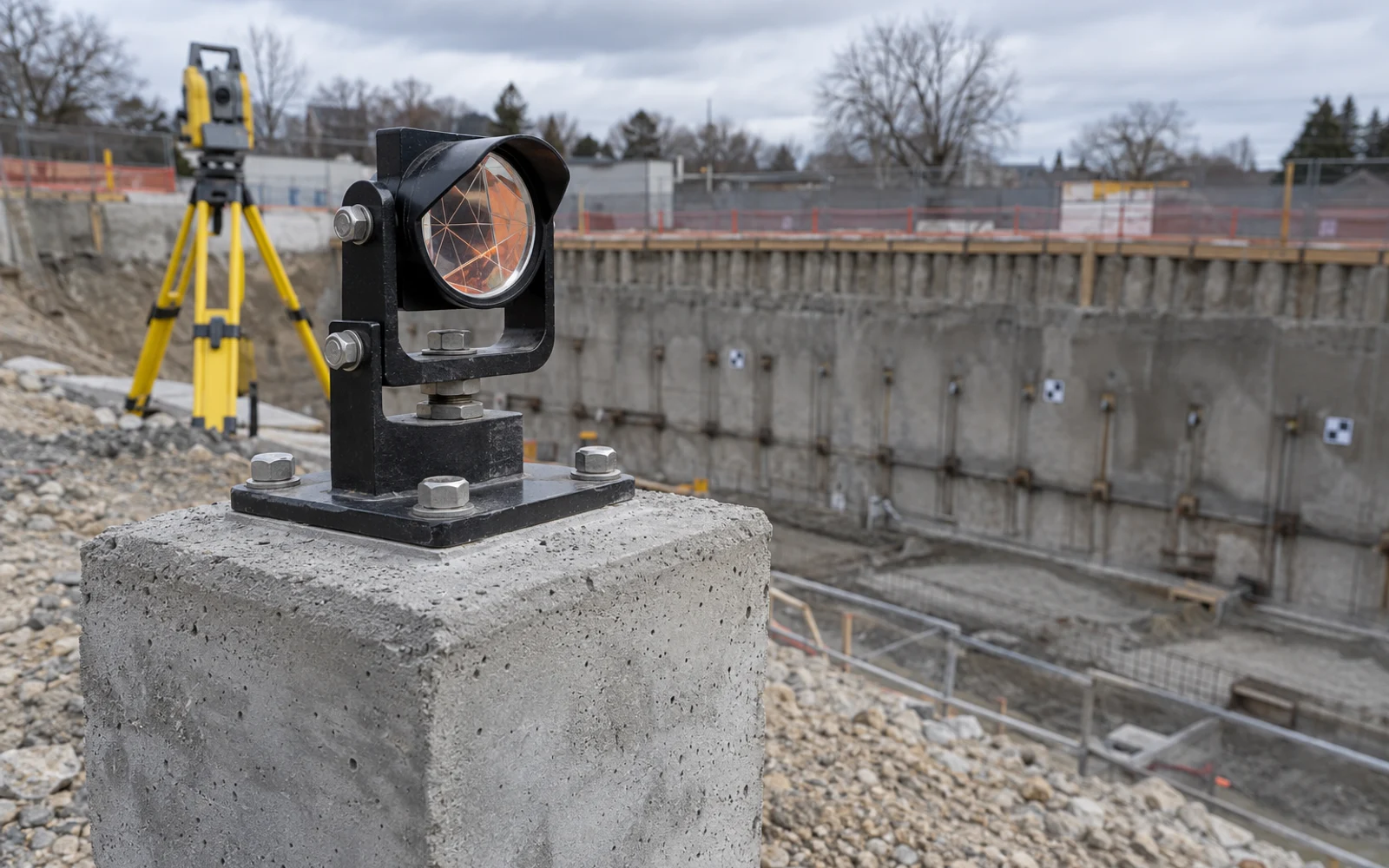
Assign every prism a persistent ID, surveyed location, role, mounting description and photograph. Explain which points constrain the instrument solution and which points are used to evaluate the asset. Keep independent check points where the project design allows them.
A reference mounted on a building can move with that building. Review foundations, temperature effects, nearby work and the expected extent of ground influence. “Far away” is not a complete stability assessment.
How should the observation cycle be designed?
The cycle must provide enough reference observations to support the instrument solution and enough asset observations to answer the monitoring question within the required time. More targets can lengthen the cycle and delay a complete picture.
| Network component | Design question | Evidence at acceptance |
|---|---|---|
| Instrument support | Can it move, vibrate or be disturbed? | Foundation and mounting record |
| Reference prisms | Are they stable and geometrically useful? | Role map and independent checks |
| Monitoring prisms | Do they represent the expected movement? | Asset-specific locations and mounting |
| Sight lines | What can obstruct or refract the path? | Visibility review across site operations |
| Observation cycle | How old can the last usable result become? | Measured complete-cycle duration |
| Environment | How are meteorological inputs handled? | Sensor source and correction settings |
Define treatment of missed targets and failed resection or orientation. A system should not quietly replace a failed reference with a monitored point merely to complete the calculation.
Review prism constants, targeting mode, coordinate axes and units in the configuration export. Reflectorless observations are not interchangeable with prism observations without a method designed for that difference.
Why can a coordinate trend change without asset movement?
A disturbed prism, changed target identity, incorrect reference coordinate or altered processing configuration can produce a step. Refraction along a heated surface can also affect observations. Record field changes before interpreting an apparent discontinuity.
Compare reference residuals with the monitored trend. If many targets shift together after an instrument intervention, inspect the reference solution. If one target changes while its neighboring points remain consistent, inspect its attachment and local structural context.
Keep the original observations and adjustment outputs when available. Document rejected observations and the reason. Repeatedly deleting unfavorable residuals can make the display look stable while reducing the network’s ability to reveal a problem.
Complementary instruments should address an independent question. An inclinometer can observe tilt; GNSS can contribute another coordinate measurement. The GNSS monitoring guide and instrument comparison explain their different dependencies.
What should the owner receive at handover?
Deliver the reference and target register, coordinate system, baseline period, observation sequence, residual criteria, missing-data behavior and recovery procedure after instrument or prism replacement. Include a demonstration that the responsible operator can identify degraded network geometry.
Define when a new baseline is justified and retain continuity with the old one. Resetting displacement to zero is an interpretive action, not routine display maintenance.
Keep the network drawing, reference checks and accepted configuration with the point history. When a prism or station changes, the relationship to the earlier measurements must remain recoverable.
FAQs
Can a total station monitor movement if its own support moves?
Some network adjustments can account for instrument movement when stable, well-distributed references remain available. The configuration and residuals must support that conclusion.
Are all prisms in a monitoring network reference points?
No. Reference prisms establish the coordinate basis; monitoring prisms observe the asset. Their roles must be explicit and reviewed when site conditions change.
Does a missed prism measurement mean zero displacement?
No. It means no accepted observation for that cycle. The display and export should retain missing or rejected status rather than carrying forward a value as current.