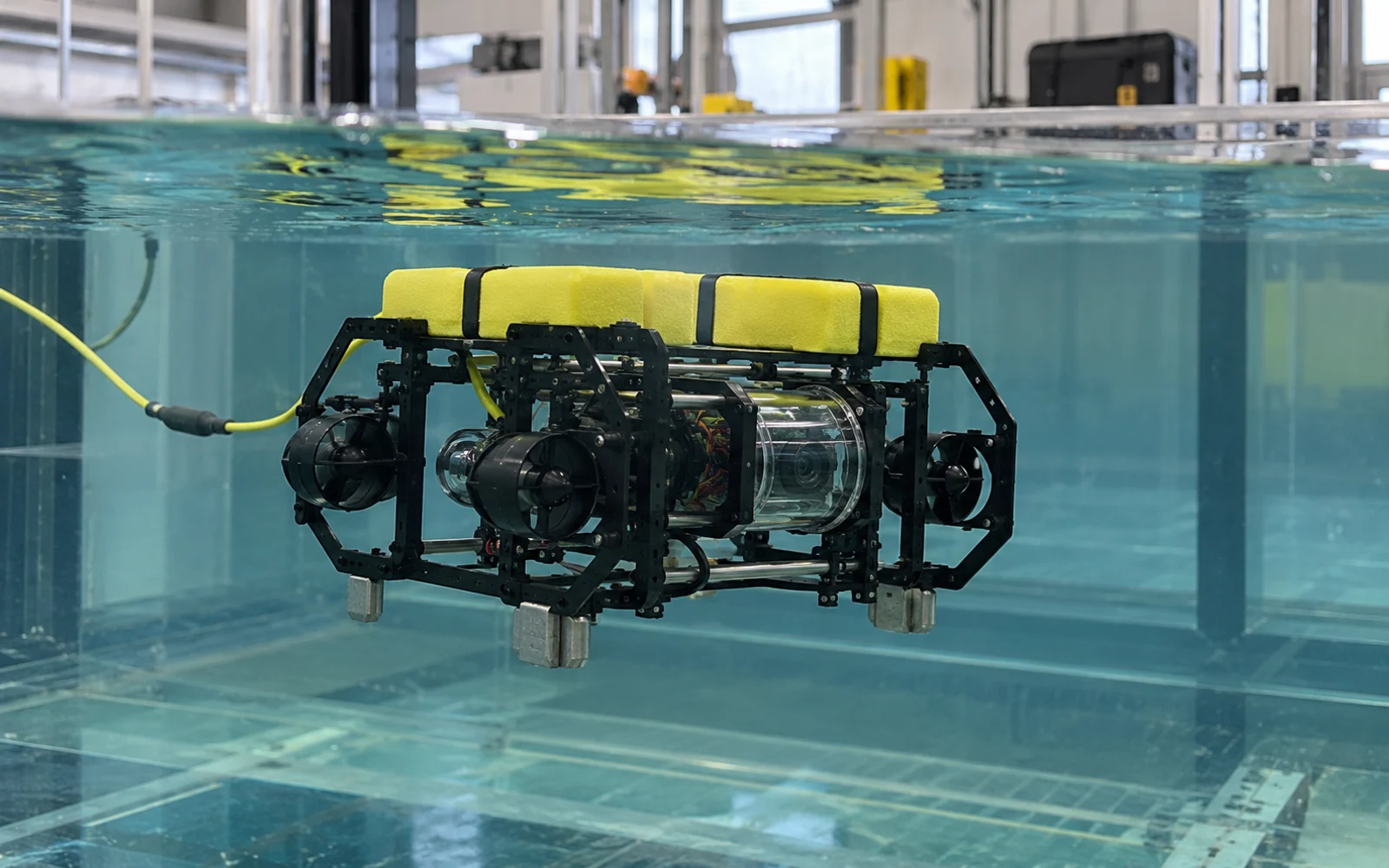
An ROV can be nearly neutrally buoyant yet sit nose-down, or float level while requiring continuous thrust to hold depth. Buoyancy and trim are separate checks. A repeatable record of the installed payload, ballast and water conditions makes the result useful when the vehicle configuration changes.
Table of Contents
Why are buoyancy and trim different?
Buoyancy describes the balance of upward buoyant force and vehicle weight. Trim describes its resting attitude. The location of buoyancy and mass matters as well as their total amounts, so a level vehicle is not necessarily neutrally buoyant.
The BlueROV2 operating guide explicitly calls for reassessing ballast when accessories are installed or removed. It describes a level, near-neutral configuration and a slightly positive preference when perfect neutrality cannot be achieved. That is platform-specific guidance, not a rule for every ROV or overhead environment.
For another vehicle, start with its approved configuration and recovery instructions. Do not add weights beyond structural limits or assume available thruster force makes an unsuitable passive balance acceptable. An attitude controller can hide a balance problem during a powered demonstration.
Test the complete configuration in controlled water
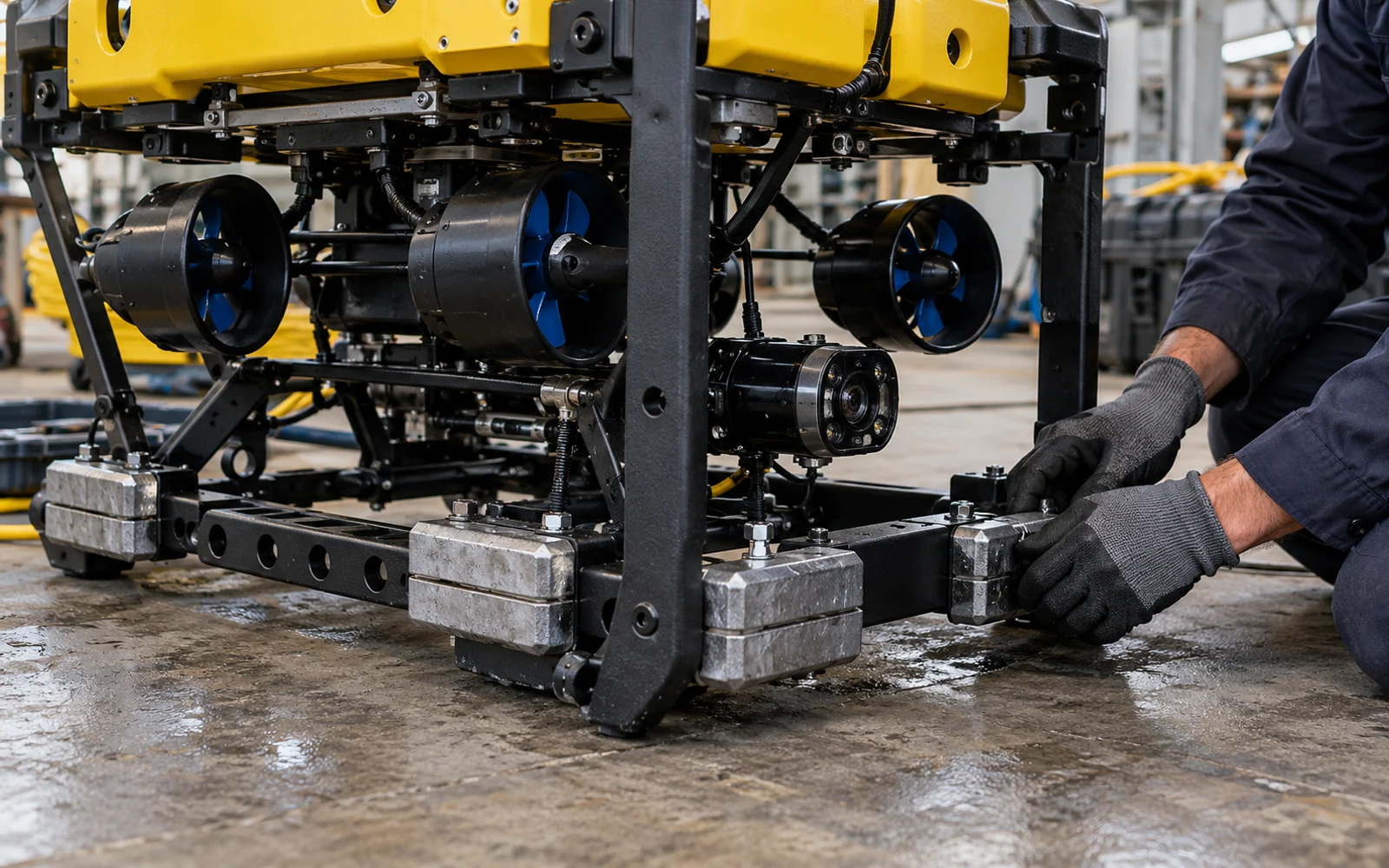
Prepare the actual configuration: battery, camera, lights, sonar, manipulator if fitted, payload brackets, cables and required tether attachment. Record any component omitted from the test. A bare-frame float test cannot release a heavier inspection configuration.
Follow the manufacturer’s sealing, electrical-isolation and handling procedures. Blue Robotics’ guide describes ballast adjustment in calm water with the vehicle powered off or disarmed. Keep people clear of thrusters, provide a controlled recovery method and have qualified personnel manage lifting and electrical hazards.
Observe vertical tendency and attitude separately with the vehicle clear of the bottom and walls. Distinguish a slow rise, a slow sink, pitch, roll and contact with the test enclosure. Repeat after a change rather than judging the result while someone is holding the vehicle.
Then examine the effect of the tether in a representative, safely managed arrangement. A line pulling upward, downward or sideways can change the observed balance. The tether-management guide owns the larger route and load-path assessment.
A payload-change record that can be repeated
Use a configuration record rather than an undocumented sequence of small adjustments. The following fields make the next trial comparable.
| Record field | What to capture | Why it matters |
|---|---|---|
| Vehicle configuration | Payload, battery, guards, cables and revision | Identifies what was actually tested |
| Ballast arrangement | Mass, location, fastening and photographs | Separates total weight from its distribution |
| Buoyancy material | Type, position, condition and approved depth | Prevents an unverified substitution |
| Water and test location | Fresh/salt water, measured conditions where available, tank clearance | Defines the test environment |
| Passive behavior | Vertical tendency, pitch, roll and observation duration | Keeps buoyancy and trim distinct |
| Tether condition | Attachment, supported length and any imposed pull | Explains external loads |
| Follow-up decision | Accepted configuration, unresolved issue or retest | Avoids releasing an ambiguous result |
Do not record only “neutral.” A later team needs to know how that judgment was made and what tolerance or operating requirement it was compared with. Preserve the before-and-after configurations when relocating ballast.
An articulated payload also changes its geometry during use; the ROV manipulator selection guide connects reach and tool force to reaction moment and vehicle control.
What changes between pool and deployment?
Water density changes buoyant force even if the vehicle’s mass is unchanged. For an illustrative fully submerged 10 L volume, changing density from an assumed 1,000 to 1,025 kg/m³ increases displaced-water mass by 0.25 kg. This is an Archimedes-based calculation, not a recommended ballast addition; real displaced volume, water density and configuration must be established.
Pressure, buoyancy-material suitability and trapped air can also make a shallow check unrepresentative. Confirm depth ratings and approved materials in the exact vehicle documentation. A successful pool observation does not certify behavior at operational depth.
External flow and a deployed tether introduce forces that the calm-water test intentionally isolates. Treat the static result as one part of readiness, then assess maneuvering and recovery through the approved operating process. Do not infer current capability or endurance from the appearance of a level float.
Release the configuration, not an assumed balance
Attach the balance record to the mission configuration and define what changes invalidate it. Moving a payload, replacing a battery type or altering a tether attachment may justify review even when total mass changes little.
Use the supplier’s payload and balance instructions to set the permitted configuration. Keep the wet-test record with the launch, recovery and inspection plan so ballast or payload changes trigger the appropriate repeat checks.
FAQs
What is the difference between ROV buoyancy and trim?
Buoyancy concerns the balance between upward buoyant force and weight. Trim concerns attitude, such as pitch and roll, resulting from the arrangement of mass, displaced volume and external loads. A vehicle can pass one check and fail the other.
Should an ROV be exactly neutrally buoyant?
Follow the vehicle's operating instructions and recovery plan. Near-neutral behavior is common, and some platforms prefer slight positive buoyancy. That preference is not universal, especially where overhead obstructions or mission constraints affect recovery.
Does a freshwater trim test remain valid in seawater?
Not without review. Water density changes buoyant force for the same displaced volume. Recheck the installed configuration in representative conditions and account separately for tether loading, pressure-rated buoyancy materials and other mission differences.