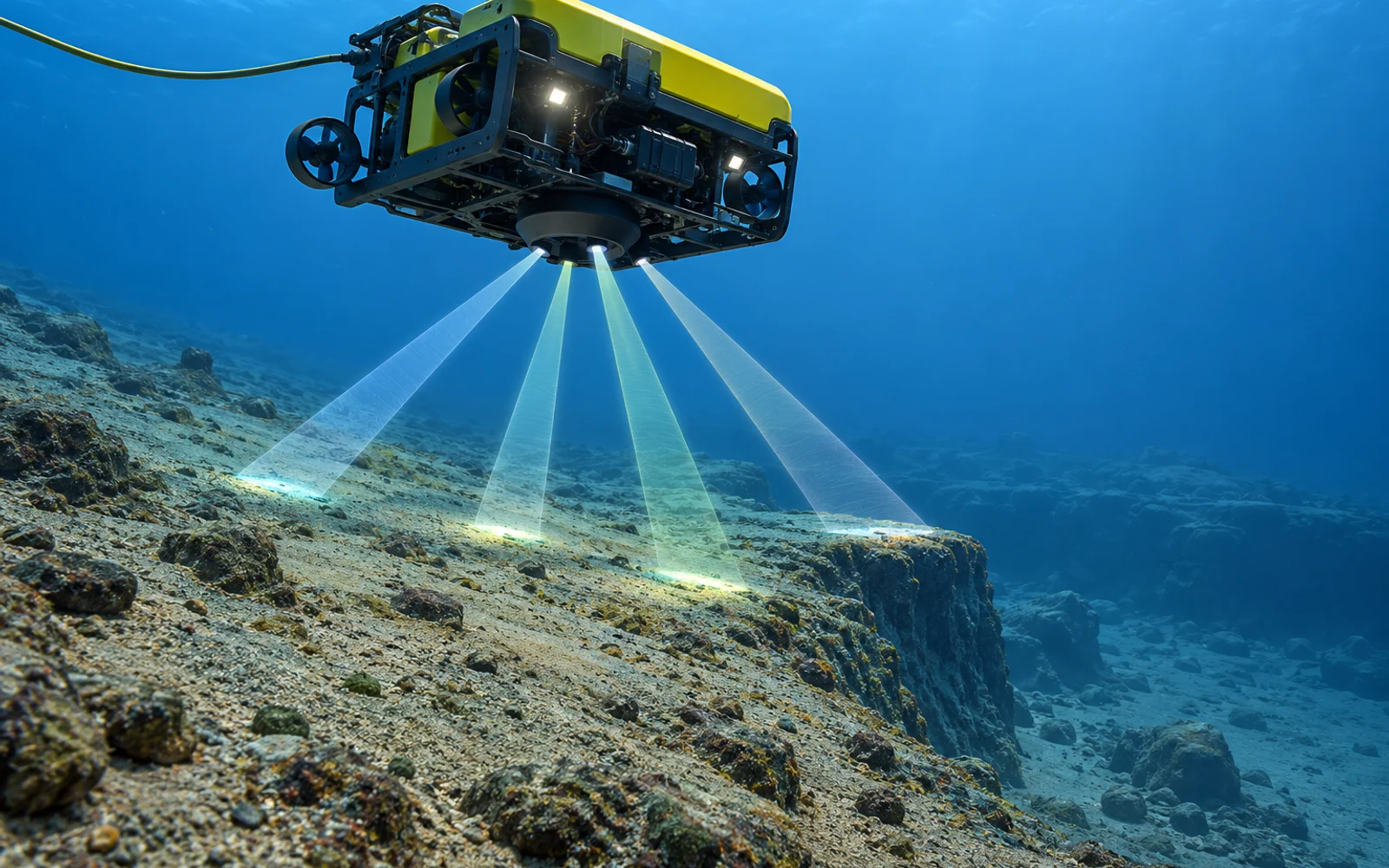
A Doppler velocity log measures ROV motion relative to an acoustic reference, usually the seabed during bottom tracking. The navigation system combines that velocity with orientation and position updates. Bottom-lock quality, integration and recovery from gaps determine how the position estimate develops.
Table of Contents
What does bottom lock actually establish?
Bottom lock means the DVL has acquired a usable acoustic return for its bottom-tracking calculation. It does not certify the vehicle’s global coordinates, the correctness of its heading or the accuracy of a camera-to-target offset.
Water Linked’s DVL documentation distinguishes bottom tracking from water tracking and identifies range, beam obstruction, bubbles, vibration and interference as possible causes of invalid velocity. Use the installed model’s manual for its precise quality fields and operating limits.
A navigation filter may integrate valid velocity over time. Errors in that velocity, timing or heading can accumulate into position drift. External acoustic positioning and known references can constrain the estimate, but they introduce their own uncertainties.
Which installation details change the measurement?
Treat the DVL as part of a coordinate and timing chain. Record its mounting orientation, position relative to the vehicle reference, output axes, units, timestamp definition and alignment convention. A correctly functioning instrument can still be integrated with a reversed axis.
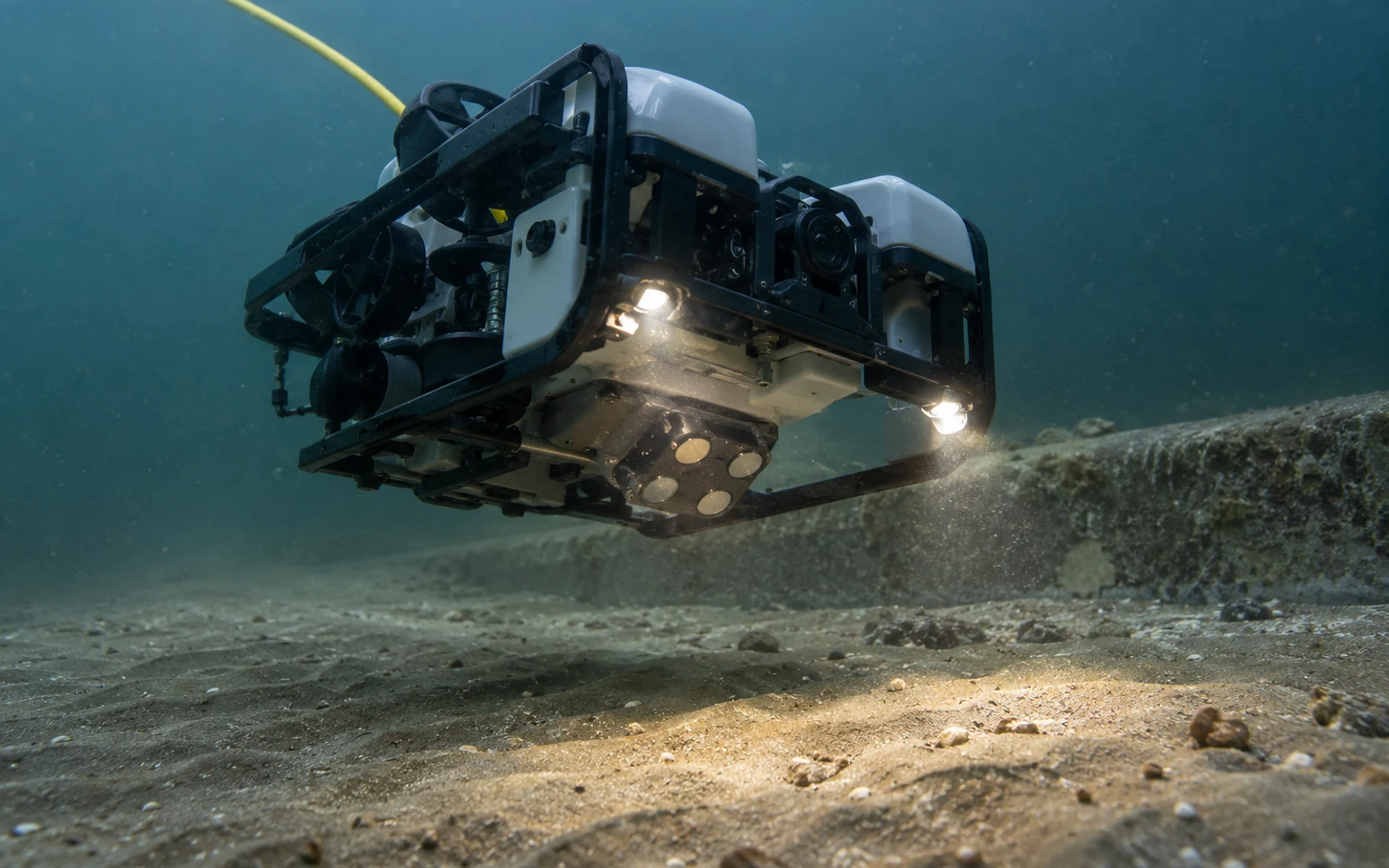
Keep the acoustic beams clear of the frame, payload, tether and turbulent flow. Inspect the arrangement with the complete operational payload fitted. A bracket that worked during a bench trial may flex under vehicle thrust or place a beam behind a newly installed tool.
Test with relevant acoustic devices and thrusters operating. An inspection sonar and DVL may perform well separately but interfere in the installed configuration. Retain simultaneous logs when diagnosing intermittent dropouts.
A validity-state contract for the pilot and recorder
Define how the operator display, navigation estimator and inspection report respond to each state. A stale value must not appear indistinguishable from a fresh measurement.
| State | Meaning to investigate | Navigation treatment to verify | Inspection record |
|---|---|---|---|
| Valid bottom tracking | Supported velocity against a bottom return | Fuse only with correct frame and time | Track quality and timestamp |
| Bottom lock lost | No dependable bottom reference | Expose degraded aiding and uncertainty | Start and end of loss interval |
| Water tracking active | Velocity relative to moving water | Use only a supported water-track model | Reference mode and current limitations |
| Data stream stale | Interface or processing stopped updating | Reject according to age limit | Last valid sample and fault time |
| Lock reacquired | Measurements resume | Check transition and discontinuity | Recovery state and position jump |
Agree these behaviors with the integrator. This table describes interface requirements; it is not a substitute for the navigation system’s approved control logic.
How should DVL performance be checked?
Use a bounded trial area with independently identifiable locations. Compare repeated paths, returns to a known point and intervals with good and poor acoustic conditions. Log the vehicle configuration, depth, altitude, heading, speed, active sonars and acoustic quality.
Do not intentionally create a navigation loss near an obstruction just to demonstrate recovery. A controlled test area or recorded-data replay can test state handling without exposing the vehicle to an unnecessary operational hazard.
A useful result reports both positional repeatability and the conditions under which that result was obtained. “The track closes” is insufficient if the system reset its origin or snapped to a reference before the comparison.
Connect navigation quality to each finding
An inspection finding should retain the navigation quality at its capture time. A target detected during a long aiding gap may be visually clear yet difficult to reacquire. Keep target IDs, nearby structure and acoustic or visual context alongside coordinates.
The ROV sonar workflow addresses the search-to-inspection handoff. USBL positioning addresses an external acoustic position estimate, a different role from local velocity aiding.
For repeat-visit work, request the installed-sensor drawing, interface definition and representative navigation logs. The logs should show how the estimator handled bottom-lock loss and recovered its position solution.
FAQs
Does a DVL provide an absolute underwater position?
A DVL primarily supplies velocity relative to its tracking reference. A navigation system combines that information with heading, timing and other aiding to estimate position.
Is water tracking equivalent to bottom tracking?
No. Water tracking measures motion relative to the water column, which may itself move. It must not silently replace bottom-relative velocity.
What should happen when bottom lock is lost?
The navigation system should expose the change in validity and follow its documented degraded-navigation behavior. The inspection record should retain the affected interval.